

Local Chimney Liner Installation in Jacksonville
A stainless liner sized to your fireplace or stove and run full height. Local family liner pros, and the flue inspection is free.
- Family owned and operated
- Free inspection and estimate
- Same-day service available
- Upfront pricing, no hidden fees
Get Your Free Inspection
Get a quote for chimney and fireplace repair and installation in Jacksonville.
Request received
Thank you. We will call you shortly to set a time.
or call (904) 920-5495
Why Choose Us
Why homeowners choose our liner specialists
- Locally owned in Jacksonville
- Family owned and operated
- 100% satisfaction guaranteed
- Free inspection and estimate
- Same-day service available
- 10% off when you book today
A liner keeps heat and smoke off the brick and the framing around it, so we size it to what burns below instead of what slides in easiest. Family owned and local, our liner specialists sweep the old flue first, fit the listed liner, insulation and cap, and leave the paperwork with you. Nothing is hidden in the price, which you approve in writing, and the install comes with our workmanship warranty. Call (904) 920-5495 and we will measure the flue for free.
- Free inspection and estimateWe sweep, measure and prove the flue on a free visit before any liner is ordered.
- No hidden feesLiner size, alloy, insulation and cap are on the written price, and that is what you pay.
- Workmanship warrantyLiner, top plate and cap all carry our workmanship warranty.
What's Included
Chimney liner installation includes
Chimney liner installation puts a listed stainless liner inside the flue, sized to the fireplace, stove or insert it serves, so heat and smoke stay off the brick and the framing. The liner pros at our local, family-run company sweep and measure the flue in a free inspection before a single part is ordered, and the price is in writing.
- Stainless liners sized to the appliance they serve
- Insulation wrap wherever the liner's listing calls for it
- Broken clay tile cleared so the liner runs clean
- Top plate and screened liner cap fastened at the crown
- Tee and clean-out at the bottom for easier sweeping
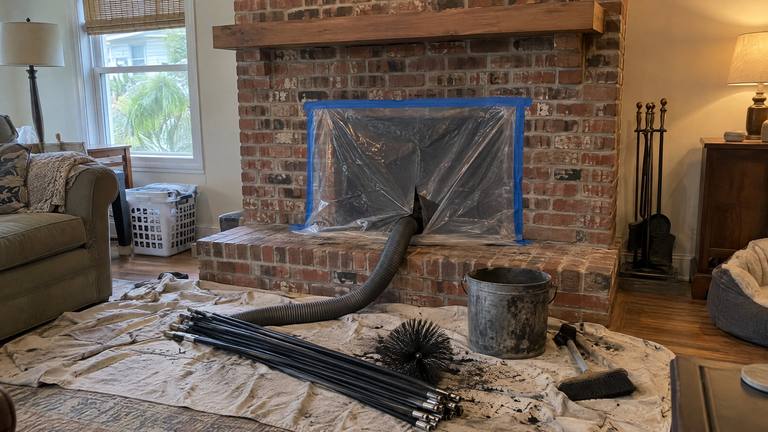
- Old flue swept before the new liner goes in
How It Works
Relining a chimney, step by step
-
Flue swept and proved
The old flue is cleaned and checked, and a test length or cone is lowered to confirm the liner will pass.
-
Liner sized to the appliance
The diameter comes from the stove collar, the insert or the fireplace opening, with insulation where the listing calls for it.
-
Liner lowered and connected
The liner goes down full height and joins a tee with a clean-out, or an adapter on the insert.
-
Top plate, clamp and cap
The top plate is fastened to the crown, the liner is clamped and trimmed, and a screened cap goes on.
10% off your first service when you book today
Relining booked today comes with 10% off your first service.
Your Options
Repair the flue or reline it?
Damage near the top of a clay flue can often be repaired. A new appliance, or cracks down the run, call for a liner.
Materials
Liner types and parts we install
- 300-series stainless liner
- Listed for wood, oil and gas appliances, rigid for straight flues or flexible for offsets.
- Acid-resistant alloy
- Offered by some makers for high-efficiency gas appliances whose cooler exhaust drops more condensate.
- Insulation blanket or poured mix
- Foil-faced ceramic wrap or a poured insulating mix, where the listing asks for it.
- Tee with clean-out cap
- At the bottom of a stove liner, so soot can be cleaned out from below.
- Top plate, clamp and screened cap
- The plate carries the liner's weight at the crown, and the cap keeps rain and animals out.
Local Conditions
Liners for coastal and inland chimneys
The liner lives inside the chimney, but its top plate and cap sit in the weather. In Atlantic Beach and Jacksonville Beach, salt air works on exposed metal, so the cap and the plate's fasteners are chosen with that in mind.
The cap also has to stay put through a blow. A storm that loosens it lets rain run straight down the liner and onto whatever sits below. Inland, from Callahan to Keystone Heights, the job and the sizing rules are the same.
Free Inspection
What we measure on a free liner visit
- Liner diameter matched to the appliance collar or the fireplace opening
- Stainless alloy and liner type chosen from the listing for the fuel
- Insulation wrap or poured insulation where the listing requires it
- Broken tile and obstructions removed so the liner runs clean
- Bottom connection: tee with clean-out cap, or an adapter to the insert
- Top plate, clamp and screened liner cap fastened at the crown
- Sweep of the old flue before the liner goes in
- Crown repairs needed to seat the top plate, listed on their own line
Estimate Factors
What goes into a relining quote
Flue height and offsets
A tall or offset flue takes more liner and more time to feed.
Rigid or flexible
Rigid sections suit a straight flue, and flexible liner bends through offsets.
Insulation
A blanket or poured mix adds material and labor where the listing requires it.
Tile to clear
Broken tile or mortar bulges that block the liner have to come out first.
Bottom connection and crown
A new thimble, a tee or insert adapter, and any crown repair under the top plate are separate lines.
FAQ
Chimney liner questions
Is relining a one-day job?
A straight flue with room for the liner usually is. Tile that has to be broken out or an offset in the flue adds time, and your written estimate shows the schedule. Call (904) 920-5495 to book the measuring visit.
What if my flue only needs a repair?
Then we say so. Damage limited to the top of a clay flue can often be repaired instead, and the estimate shows both options when both are real.
Do you install liners for wood stoves and inserts?
Yes. A stove or insert gets a liner sized to its collar and connected at the bottom, so it drafts the way its maker intended.
Is Fernandina Beach too far for you?
Not at all. We reline chimneys from Fernandina Beach and Yulee out to Callahan and Hilliard, and the visit to measure is free.
Is the liner price given up front?
Yes. Liner size, alloy, insulation and cap are all on the written estimate after a free inspection, and that is the price you pay for that scope.
Common Problems
Flue problems a new liner solves
Cracked or missing clay flue tiles
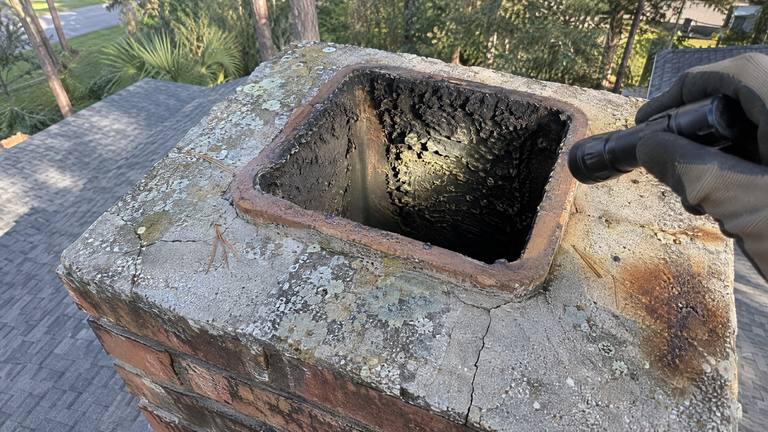
Heat can reach the brick and nearby framing. A listed stainless liner closes the gap, or a few tiles near the top are repaired.
New stove or insert going in
The old flue was sized for an open fire. A liner sized to the appliance collar restores the draft it needs.
Heavy creosote above a stove
Slow exhaust is cooling in an oversized flue. A liner sized to the collar keeps the gases moving and warmer.
Drips at the damper on dry days
Condensation from an appliance venting into a large, cold flue. A correctly sized liner cuts it.
Two appliances on one flue
One maker bars a liquid-fuel appliance on a liner that vents a wood stove, so each gets its own path.
Specialized Services
Clay flue tile repair
Our Services
Inspection, sweep and rebuild work
-
-
-


Get a free liner inspection
Your flue is swept and measured by a local pro, and the liner size, alloy and price go on paper.
Free InspectionFull service details
What the code asks of a flue lining
The Florida Building Code, Residential, section R1003.11, says masonry chimneys shall be lined, with lining suited to the appliance under its listing and the maker's instructions. A liner keeps flue heat from soaking through the masonry toward framing, gives the smoke a passage of the right size, and stands up to the acids and moisture that condense out of flue gases.
The code accepts clay tile to ASTM C315, UL 1777 listed liner systems and other approved materials (R1003.11.1). To reline a chimney that is already standing, new clay tile would mean taking it apart, so chimney flue liner installation here uses a UL 1777 listed stainless system.
Sizing from the appliance down
Flue liner replacement asks the same question as a first install: what will this flue carry? For a wood stove or insert, the liner's area must not be less than the appliance's outlet collar, and one maker caps it at three times the collar area, because an oversized flue lets the gases slow and cool. For an open masonry fireplace the flue is at least one-twelfth of the opening when round and one-tenth when square (FBC R1003.15.1). Gas appliances follow the NFPA 54 venting tables and their manual. A round liner pressed oval changes its area, so the numbers are checked again after shaping.
Stainless, aluminum, rigid or flexible
Makers list their 300-series stainless liners for wood, oil and gas, and some offer a more acid-resistant alloy for high-efficiency gas appliances. Aluminum liners are listed only for Category I gas appliances, which rules them out for any flue serving wood. Rigid sections suit a straight flue, and flexible liner bends through offsets and takes up expansion as it heats.
When an insulated chimney liner is needed
When the chimney's own clearance to framing cannot be confirmed, liner makers require an approved insulation, a foil-faced ceramic blanket or a poured mix, and with it the listed system can sit at zero clearance to combustibles. An insulated chimney liner also keeps flue gases warmer, which helps the draft and cuts condensation, most of all on an outside wall. The flue is measured with the insulation thickness included.
Chimney relining starts with the old flue
Liner instructions call for the chimney and smoke chamber to be cleaned and the structure checked first, and NFPA 211 lists relining as a moment for a thorough evaluation. Chimney liner replacement follows the same preparation when an older metal liner has failed. Broken tile is cleared, damaged tile at the top is cut back flush, and a test length or guide cone lowered from the top proves the liner will pass the offsets and mortar bulges.
The top, the bottom and the limits of a liner
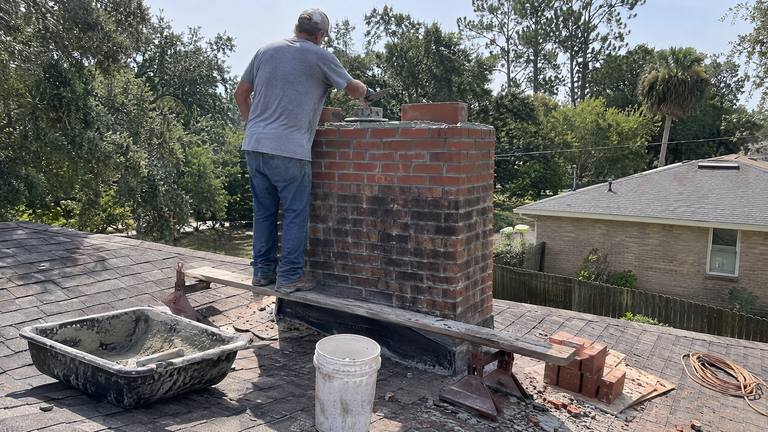
For a stove, the liner ends in a tee whose branch meets the connector through a thimble, with a removable cap below for cleaning out soot, and the wall opening goes where it can be reached. A wood-burning insert takes an adapter on its collar, and a gas unit set into a firebox belongs to gas fireplace insert installation. The top plate carries the liner's weight and is fastened to the crown, a clamp grips the liner, and a screened cap goes on.
A liner carries smoke. A leaning stack, a leaking crown or crumbling brick are masonry problems that come first, and damage limited to a few clay tiles is chimney flue repair.
First fires and permits
Liner makers set their own break-in schedules, and we leave the instructions and installation record with you. Relining can need a building permit, and we tell you whether one is expected and who files it. To start, call (904) 920-5495 and book the free inspection.
Guides
Chimney and fireplace guides
- The variables behind a relining quoteA liner is sized to the appliance first and fitted to the chimney second. Each of those steps adds work or takes it away.
- Clay, stainless, aluminum or cast-in-place: choosing a flue linerFour liner types do the same job in different ways. The appliance decides which of them can do it in your chimney.
- Which chimney and fireplace jobs call for a permitFlorida law sets the rule and the local building department applies it, job by job, for chimney work.
- What a cracked flue tile puts at riskA cracked clay tile can draw smoke perfectly well while it passes heat toward the framing. What cracks tiles, what gets through, and the three ways back to a sound flue.
- When the code requires a chimney liner, and when yours needs a new oneThe Florida Building Code settles the first question. Your appliance and the state of the old flue settle the second.