
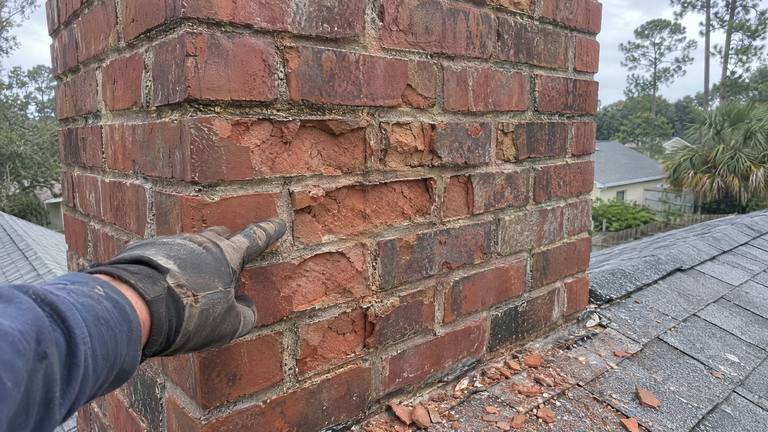
Local Chimney Masonry Repair in Jacksonville
Crumbling mortar and broken brick repaired with a matched mix. Local, family-owned masons and a free inspection.
- Fully licensed and insured
- Locally owned
- Family owned and operated
- Same-day service
Get Your Free Inspection
Get a quote for chimney and fireplace repair and installation in Jacksonville.
Request received
Thank you. We will call you shortly to set a time.
Quicker by phone? Call (904) 920-5495
Why choose us
Masonry repair goes wrong when the mortar is harder than the brick, or when the water that caused the damage is left alone. As a family-run, local chimney masonry contractor, we name the mortar type, match the brick, and close the water path before touching the joints. Every line is priced in writing before work starts, and 10% comes off whatever you book in the three days after the inspection. Book the free inspection at (904) 920-5495.
Brick and mortar work by the local chimney and fireplace pros
- Locally owned in Jacksonville
- Family owned and operated
- 100% satisfaction guaranteed
- Free inspection and estimate
- Same-day service available
- 10% off any service
- Locally ownedWe are locally owned, so the mason who cures a test batch against your brick is the one who comes back to lay the real mortar.
- Workmanship warrantyEvery joint we repoint and brick we replace is backed by our workmanship warranty.
Chimney masonry repair covers
Chimney masonry repair means open joints, cracked or spalled brick and loose rows of brick at the top, fixed so the wall sheds water again. We are family owned and local, and our masonry pros start with a free inspection that finds where the water gets in, names the mortar type and matches your brick before any price is written.
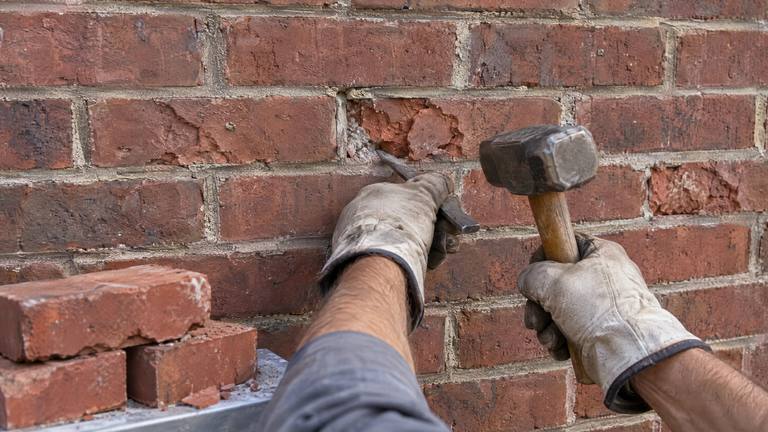
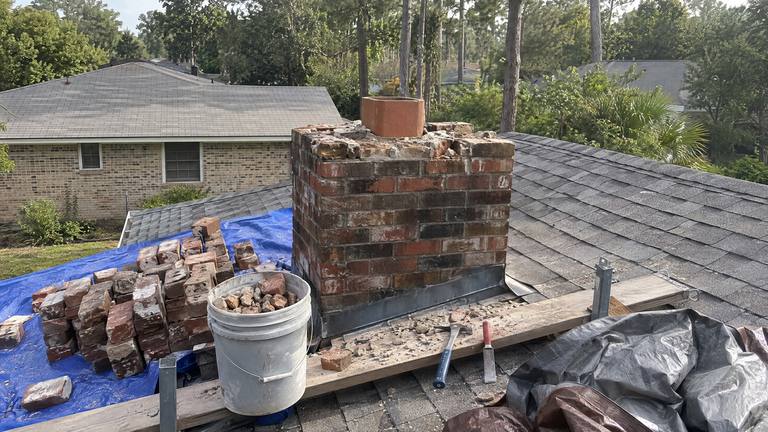
- Cracked and spalled bricks cut out and replaced
- Open joints raked out and repointed with matched mortar
- Loose rows of brick at the top taken down and relaid
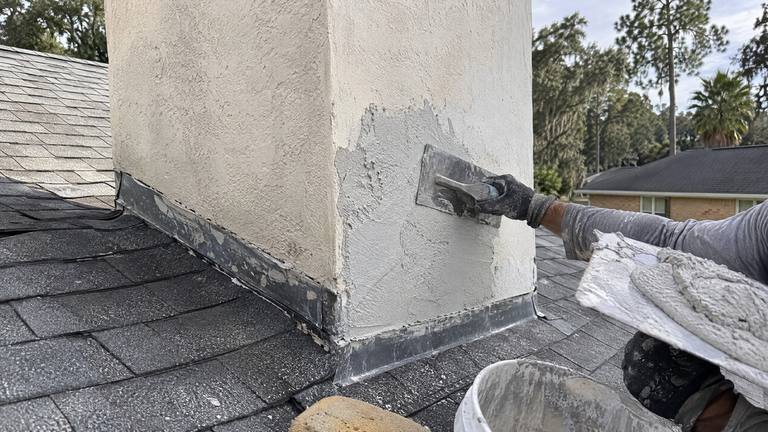
- Stucco and stone chimneys repaired to match
- Color test batch cured against your brick first
- Gap between chimney and house checked and explained
Chimney brick and mortar repair up close

Chimney masonry repair, start to finish
-
Water path traced first
We check the crown, the cap, the shoulders, the weather side and the flashing before pricing joints or brick.
-
Joints raked, bad brick cut out
Worn mortar is raked back to sound depth, and cracked or spalled units come out without thinning the wall.
-
Matched mortar packed and tooled
Pre-hydrated mortar of the type on your estimate goes in, with salvaged or new brick matched for size and color.
-
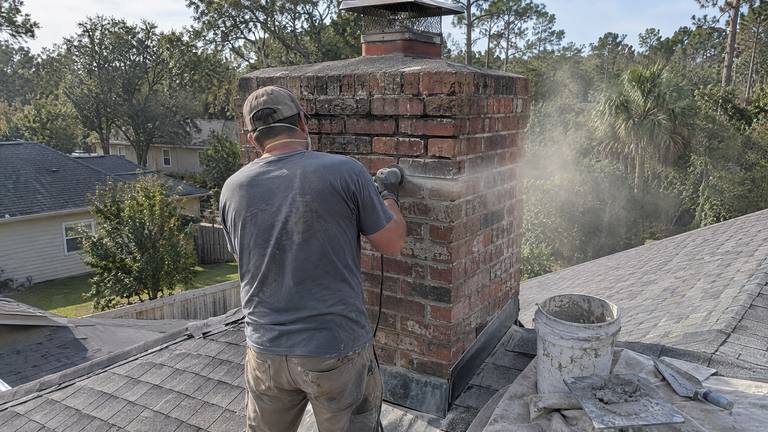
Brick cleaned the gentle way
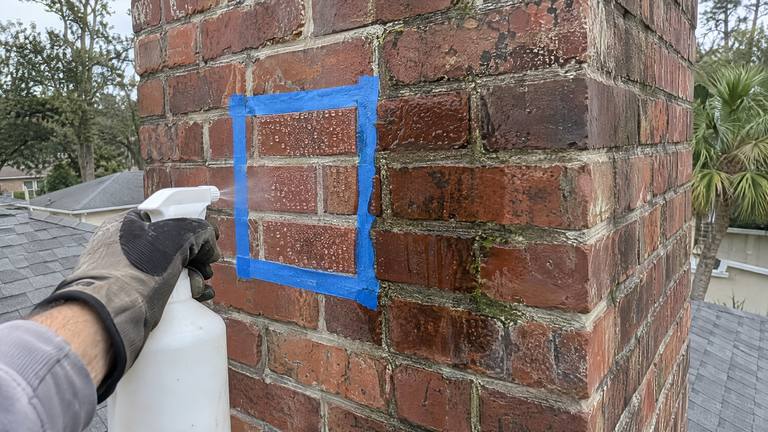
Smears come off with a brush and water while they are fresh, and no harsh acid touches the brick.
10% off any service booked within 72 hours of inspection
Loose brick or crumbling mortar, the masonry you book in those 72 hours is 10% off.
Repoint, replace brick or rebuild the top?
Scattered damage gets repaired. When the damage runs through the wall, rebuilding the top is the better repair.
Specialized masonry services
-
-
-
-
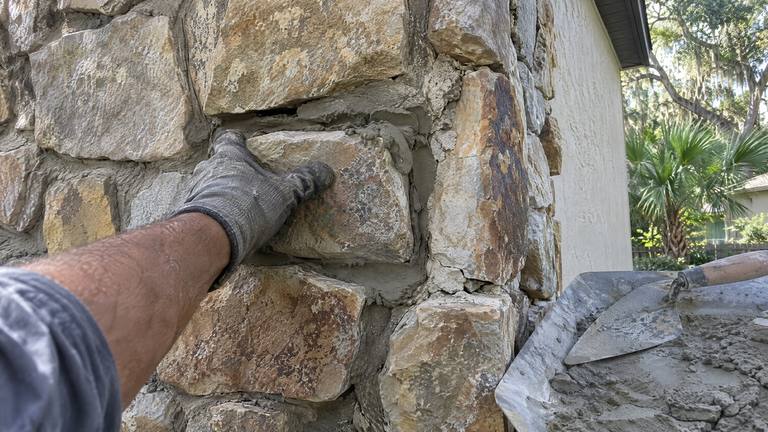


Mortar and brick matched to your chimney
- Type N mortar
- BIA's recommendation for chimneys above grade, balancing bond and workability.
- Type S mortar
- The alternate where more flexural bond is needed.
- Salvaged or new brick
- Matched for size, color and texture, and set into the old coursing.
- Pre-hydrated repointing mix
- Mixed damp and left to stand so it packs into the joint and shrinks less as it cures.
- Brick-safe cleaners
- Only ones the brick maker allows, tested on a small area first. Unbuffered muriatic acid stays off the wall.
Where a masonry estimate comes from
How much of the wall is affected
A few joints and bricks cost less than a full face or the whole top.
Brick match
Salvaged or special-order brick can take longer to find than stock units.
Height and access
A tall stack on a steep roof needs staging and roof protection.
Water path repairs
Crown, cap and flashing fixes that stop the damage are separate lines.
Stucco or stone finish
Refinishing stucco or resetting stone takes more hand work than brick.
Other work on your chimney
-
-
-
-
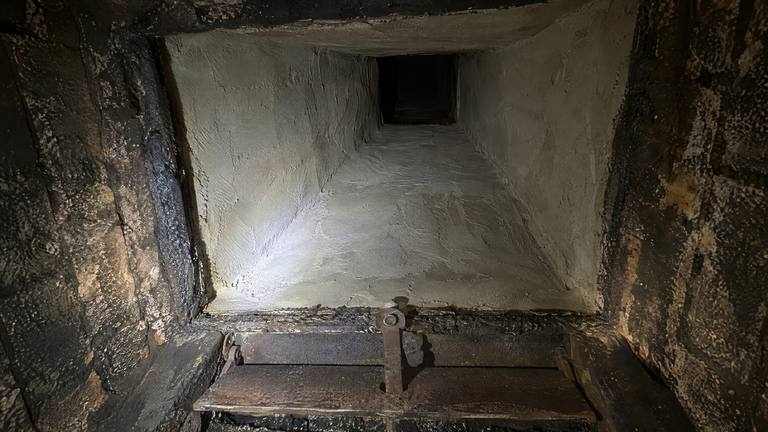


Brick, mortar and the storm season
Water is the first suspect in chimney masonry decay. It carries salts, softens old mortar and leaves crystals growing behind the brick face as it dries. In a tropical storm, wind drives rain into the weather side of the stack, so the shoulders and that face get the closest look.
Salt exposure can add to the salts in masonry, but the repair still begins with the source of water. Closing that path before repointing or replacing brick helps address why the damage developed.
Checked on every masonry inspection
- Each failed area located and sized: open joints, cracked units, loose courses
- The mortar type named under ASTM C270, and the reason for that type
- The brick match: salvaged or new, with size, color and texture
- How deep joints are raked and how the new joints are tooled
- The water path that caused the damage, and the repair that closes it
- How we reach the stack and protect the roof while working
- The point where repair stops and a partial rebuild becomes the better choice
- Work that can wait, with what to watch in the meantime
Chimney masonry questions
Will the repair stand out against my old brick?
We mix a test batch of mortar and let it cure against your brick before the real work, and matched or salvaged brick goes in. From the ground, a good repair reads as part of the wall.
Are you able to start masonry work soon?
The estimate visit can often happen the same day, and the repair itself is booked around dry weather. Call (904) 920-5495 and you get the start date with the written price.
How can I prepare for a brick chimney repair visit?
Describe the cracked joints, loose brick or staining you have noticed without climbing to inspect it yourself. A chimney mason from our family crew checks the damage and discusses the mortar and brick match before pricing the repair.
What is written on the masonry estimate?
Each damaged area, the mortar type, the brick match and how we reach the chimney. Work that can wait is marked so you can plan it, and the inspection behind it is free.
When is a rebuild smarter than a repair?
When loose brick runs through the wall or the top has shifted out of line, relaying that section is sounder than patching it. We show you where that line is and price both when both are real options.
Will you clean the mortar off the brick when you finish?
Yes. Joints are tooled as we go, smears are brushed off before they set, and any cleaner we use is one the brick maker allows, tried on a small patch first. The site is cleaned before we leave.
Brick and mortar damage we repair
Mortar crumbling out of the joints
Water and time have worn the joints. They are raked back to sound depth and repointed with a matched mix.
Brick faces flaking or popping off
That is spalling, usually from trapped water. Damaged units are cut out and replaced, and the water path is closed.
Stair-step crack along the joints
The masonry moved and the mortar gave, as it is meant to. Once the movement has stopped, the joints are repointed.
Crack running straight through the bricks
The units themselves took the stress. Cracked brick comes out, and we check the footing and the ties to the house.
White crust on the brick
Salt left by water leaving the masonry. It maps where the water is getting in.
Loose bricks at the top of the chimney
The top rows of brick have lost their mortar. They are taken down and relaid, or the top is rebuilt.
Set up a free masonry inspection
Joints, brick and the water path all get checked by a local chimney pro before anything is priced.
Free InspectionFull service details
Brick and mortar work as a pair
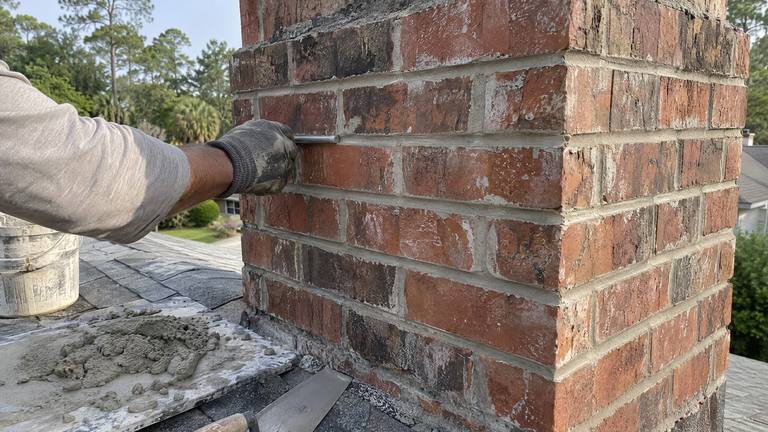
The brick in a chimney is hard and slow to change. The mortar between the units is softer by design, so the movement of a stack that heats, cools, wets and dries goes into the joints, which can be raked and refilled, and stays out of the brick faces, which cannot. So any masonry chimney we repair starts with a look at the existing wall, and good work on brick is mostly matching. The Brick Industry Association's guidance says to pick the mortar type with the lowest compressive strength that meets the job, because stronger is not necessarily better.
ASTM C270 mortar types for a chimney
ASTM C270 sorts mortar into Types M, S, N and O. For parapets and chimneys above grade, the BIA table recommends Type N, with Type S as the alternate. For repointing, the repair mortar's compressive strength should be equal to or less than the mortar already there, because a harder mix concentrates stress at the brick edges and BIA names the result: spalling of the brick it was meant to protect. Repointing mortar is also pre-hydrated, mixed damp and left to stand, so it packs into the joint and shrinks less.
Chimney crack repair
A crack that steps up the stack along the joints means the masonry moved and the mortar gave, and once the movement has stopped those joints are repointed. A crack straight through the units means the brick carried the stress, and cracked units are replaced. A crack the full height of the stack, a chimney tipping away from the house or a gap opening at the roof line points to the footing or the ties. On a cracked chimney, repair starts there, or it will not last. We mark the ends of a crack we are unsure about and check it again later.
Water first, then the trowel
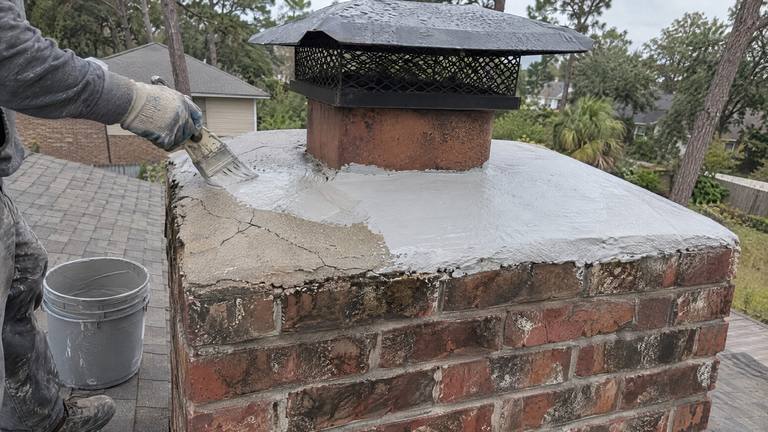
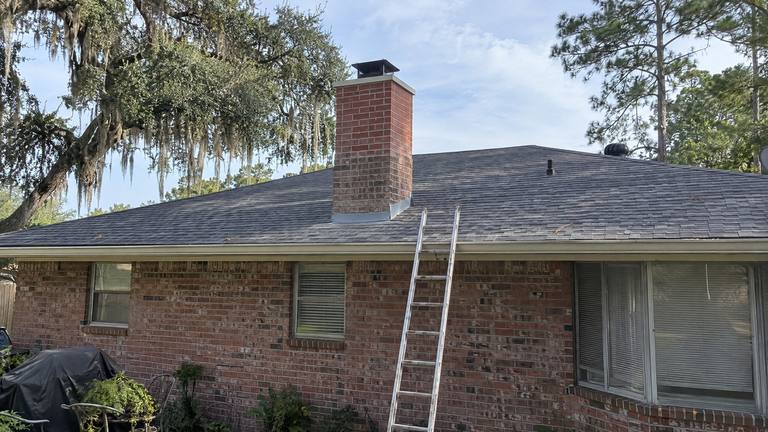
Above the roofline, water is the first suspect. Before pricing joints and units we trace the path: the crown and its seal at the flue tile, the cap, the shoulders, open joints on the weather side and the flashing line. BIA's chimney note asks that a mortar wash on the shoulders fill each step on its own, and a wash that has cracked away sends water into the middle of the chimney. Our guide on white stains on chimney brick explains how salt deposits map the water.
Chimney brick repair, joint by joint
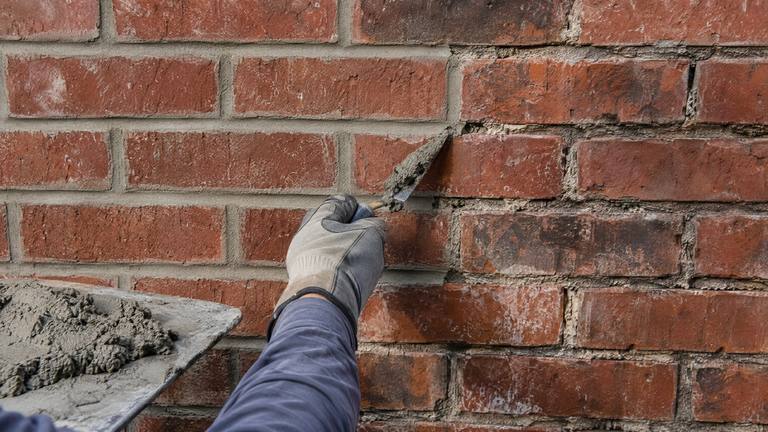
Most chimney brick repair falls into one of four jobs. Worn joints in sound brick call for chimney tuckpointing. Cracked or flaking units call for spalling brick repair. Cement plaster over block or framing is stucco chimney repair. Natural or manufactured veneer is stone chimney repair.
FBC Residential R1003.10 sets masonry chimney walls at no less than 4 inches nominal, so resetting units must not thin the stack. R1003.18 keeps an air space to combustible framing, 2 inches inside or within an exterior wall and 1 inch entirely outside, and mortar droppings stay out of it. A relaid top still has to clear the roof by 3 feet and stand 2 feet above anything within 10 feet, per R1003.9.
Cleaning the wall and reading the estimate
BIA's stain guidance warns against unbuffered hydrofluoric or hydrochloric (muriatic) acid, which can leave white scum or draw out vanadium stains. Any cleaner is one the brick maker allows, tested on a small area, and high-pressure water stays away from fresh joints.
A masonry estimate, ours or anyone's, should name each area of work with its size, the mortar type and why, the brick source, the joint depth and tooling, the water path and how it is closed, and the access method. Book a free inspection at (904) 920-5495 and hold ours against that list.
Chimney and fireplace guides
-
-
-


Chimney Masonry Repair by Town
- American Beach
- Arlington
- Atlantic Beach
- Avondale
- Baldwin
- Bayard
- Bellair-Meadowbrook Terrace
- Brentwood
- Brooklyn
- Bryceville
- Callahan
- Clay Hill
- Crawford
- Doctors Inlet
- Fernandina Beach
- Fleming Island
- Fruit Cove
- Garden City
- Green Cove Springs
- Hilliard
- Jacksonville Beach
- Julington Creek Plantation
- Keystone Heights
- Kings Ferry
- Lake Asbury
- Lake Geneva
- Lake Shore
- Lakeside
- Mandarin
- Mayport
- Middleburg
- Murray Hill
- Nassau Village-Ratliff
- Nassauville
- Neptune Beach
- Nocatee
- Northside
- O'Neil
- Oakleaf Plantation
- Oceanway
- Orange Park
- Ortega
- Palm Valley
- Panama Park
- Penney Farms
- Ponte Vedra Beach
- Riverside
- San Jose
- San Marco
- Sandalwood
- Sawgrass
- Springfield
- St. Nicholas
- Sunbeam
- Switzerland
- Tallulah-North Shore
- Yulee