
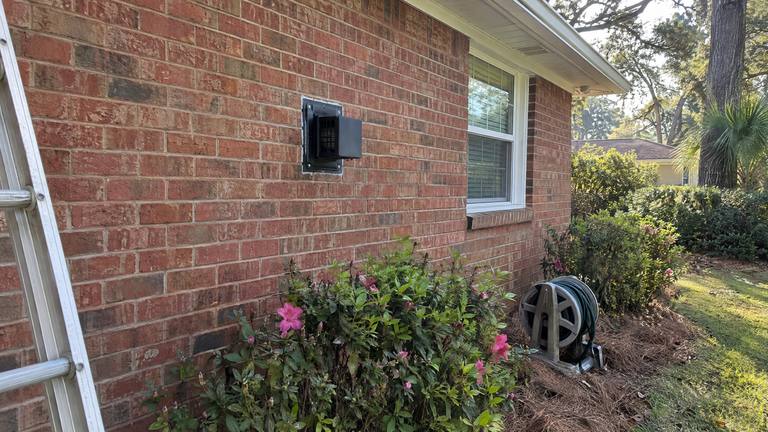
Gas Fireplace Venting by Local Jacksonville Specialists
Gas fireplace vent pipe, joints and caps traced and repaired by local, family-run venting specialists, starting with a free inspection.
- Fully licensed and insured
- Locally owned
- Family owned and operated
- Same-day service
Get Your Free Inspection
Get a quote for chimney and fireplace repair and installation in Jacksonville.
Request received
Thank you. We will call you shortly to set a time.
Quicker by phone? Call (904) 920-5495
Why choose us
A gas fireplace is only as safe as the pipe that carries its exhaust outside. A family-owned local team of venting pros traces every vent run from the collar to the cap, fixes separated joints and corroded sections, and moves caps that now sit too close to a window or deck. Every repair ends with a spillage check, and the price is in writing before we start. Call (904) 920-5495 to have the vent run checked.
A family team for gas fireplace vent repair
- Locally owned in Jacksonville
- Family owned and operated
- 100% satisfaction guaranteed
- Free inspection and estimate
- Same-day service available
- 10% off any service
- Free inspection and estimateWe follow the vent from the collar to the cap and measure where the vent cap sits at no charge.
- Upfront pricing, no hidden feesEvery joint, section and vent cap fix is priced in writing before we cut or reseat anything.
- Workmanship warrantyEach repair ends with a flame check, and the joints and sections we touch fall under the workmanship warranty.
Vent repairs our specialists make
Gas fireplace venting is the pipe that carries exhaust outside, either a sealed direct-vent run through a wall or roof or a Type B vent rising above the roof. Our venting specialists trace it joint by joint from the collar to the cap and repair what has separated or corroded. The work comes from a local, family-owned company, and the inspection that traces your vent is free.
- Separated or unlocked vent joints reconnected and secured
- Rusted or dented vent pipe replaced section by section
- Direct vent termination caps moved away from windows
- B-vent installation for new runs, laid out from the vent table
- Spillage and flame check after every repair
Tracing and fixing a gas fireplace vent
-
Read the manual and markings
The appliance manual and the markings on the pipe give the vent type, the size and the maker's vent table.
-
Follow the run joint by joint
With the unit off and cool, we trace the vent through the wall, chase or attic and check each joint for separation and its lock.
-
Reseat, replace or reroute
Separated joints are reseated and locked, damaged sections are replaced with pipe from the listed vent system, and crowded caps are moved.
-
Fire it and check for spillage
We run the unit and watch the flame and, on a B-vent, the draft hood for spillage, then note each fix on the ticket.
10% off any service booked within 72 hours of inspection
Vent acting up? The check and the repair both take the 10% off.
Reseat, replace or reroute the vent
Direct-vent and B-vent repairs stay inside the vent system the appliance is listed with.
Other gas fireplace installation work


Every vent joint and cap on the inspection sheet
- Vent type, size and maker, from the appliance manual and the pipe markings
- Every joint we can reach, checked for separation and locking
- Clearance from the pipe to combustibles, per its listing
- Termination location against openings, grade and the manual's diagram
- Rise, run, elbows and restrictor setting against the vent table
- Vent pipe sections to replace or reseal, one by one
- A spillage or flame check after the repair
Gas fireplace venting questions
Could the vent be why my fireplace shuts off?
It can be. A vent that is not drawing or is pulling exhaust back in is one cause we test for. Others sit inside the appliance, and we check those on the same visit.
Can you move a vent cap away from my new deck?
Yes, where a new route meets the manual's diagram and the code's clearances. We draw it out for you on a free inspection before we cut anything.
I smell exhaust when the fireplace runs. What now?
Turn it off and open windows. If a carbon monoxide alarm sounds or anyone feels ill, get everyone out and call 911 from outside. Once everyone is safe, call us to check the vent.
Are wall and roof vent terminations both part of the service?
Both are included in the vent assessment where they belong to the installation. There is no charge to inspect and quote the work. Call (904) 920-5495 and describe the termination only if you can see it safely from the ground.
Is a gas fireplace vent pipe replacement quoted in writing?
Yes, section by section, and the quote costs nothing. The number does not change unless you approve new work.
Vent problems our experts trace
Fireplace shuts itself off after a while
A vent that is not drawing, or that pulls exhaust back into the intake, can shut a unit down. We trace the run and test the draft.
Blue, lazy, see-through flames
One maker lists this as the sign of a vent blockage. We check the vent cap outside for nests or debris and every joint for separation.
A new deck built near the vent cap
The terminal needs its clearances from windows, doors, grade and the manual's diagram. We move the cap to a spot that meets them.
Stains on the siding above the cap
A shifted wall thimble or siding cut tight can crush the outer pipe or open the joint behind the cap. We find which and repair it.
Get your gas fireplace vent traced free
Our venting pros follow the pipe from collar to cap and put every fix and its price in writing.
Free InspectionFull service details
Direct-vent and B-vent gas fireplace venting
A direct-vent fireplace is sealed. Its vent is two pipes in one, with exhaust leaving through the inner pipe and outdoor air coming in around it, ending at a termination cap on a wall or above the roof. A B-vent fireplace burns room air and relies on warm exhaust rising through a Type B double-wall vent, which section 502.1 of the Fuel Gas volume requires to be listed and tested to UL 441.
The two designs cannot be swapped, so a repair keeps the vent the appliance was built for.
Vent tables and termination clearances
The maker's vent table sets the rise, run, elbows and restrictor setting for a direct-vent run. Table 503.8 of the Fuel Gas volume sets the distance from a direct-vent terminal to an operable window or door by the appliance's input and keeps it at least 12 inches above grade. A B-vent terminates at least 5 feet above the highest draft hood outlet, with its cap height set by roof pitch under section 503.6.
Direct vent fireplace repair and new vent runs
On a direct-vent unit, the repair starts at the joints. An inner pipe pulled apart inside the outer one feeds exhaust back into the intake, and one maker lists a blue, lazy, transparent flame as the sign of a blockage. B-vent runs separate at joints, corrode where exhaust condenses, or lose their cap.
When a B-vent pipe needs replacement, or a direct-vent section is damaged, the new section comes from the listed vent system, and a restrictor is reset to the position the vent table gives. A new run is laid out from the vent table before the first hole is cut, with firestops and wall thimbles where the pipe crosses framing, and direct-vent pipe installation follows the maker's parts list. Repairs to the roof covering belong to a roofer.
To have your vent run traced for free, call (904) 920-5495.

Gas Fireplace Venting by Town
- American Beach
- Arlington
- Atlantic Beach
- Avondale
- Baldwin
- Bayard
- Bellair-Meadowbrook Terrace
- Brentwood
- Brooklyn
- Bryceville
- Callahan
- Clay Hill
- Crawford
- Doctors Inlet
- Fernandina Beach
- Fleming Island
- Fruit Cove
- Garden City
- Green Cove Springs
- Hilliard
- Jacksonville Beach
- Julington Creek Plantation
- Keystone Heights
- Kings Ferry
- Lake Asbury
- Lake Geneva
- Lake Shore
- Lakeside
- Mandarin
- Mayport
- Middleburg
- Murray Hill
- Nassau Village-Ratliff
- Nassauville
- Neptune Beach
- Nocatee
- Northside
- O'Neil
- Oakleaf Plantation
- Oceanway
- Orange Park
- Ortega
- Palm Valley
- Panama Park
- Penney Farms
- Ponte Vedra Beach
- Riverside
- San Jose
- San Marco
- Sandalwood
- Sawgrass
- Springfield
- St. Nicholas
- Sunbeam
- Switzerland
- Tallulah-North Shore
- Yulee