
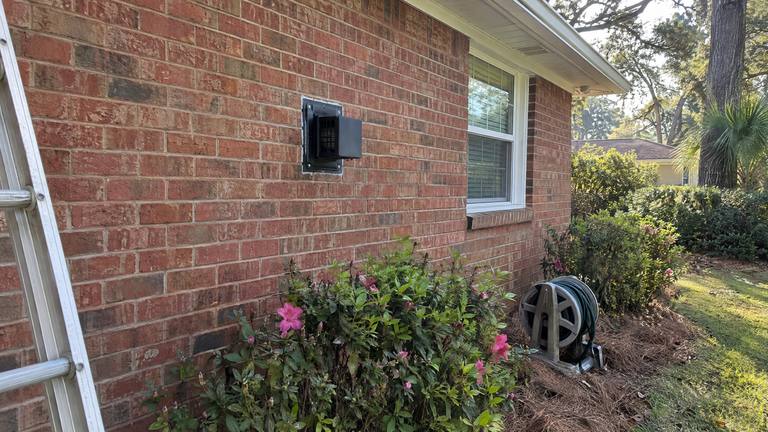
Family-run gas fireplace venting in Keystone Heights
Your Keystone Heights gas fireplace vent traced joint by joint at no charge, with each fix written down by our family crew.
- Fully licensed and insured
- Locally owned
- Family owned and operated
- Same-day service
Get Your Free Inspection
Get a quote for chimney and fireplace repair and installation in Jacksonville.
Request received
Thank you. We will call you shortly to set a time.
Quicker by phone? Call (904) 920-5495
Gas fireplace venting experts for Keystone Heights homes
- Locally owned in Jacksonville
- Family owned and operated
- 100% satisfaction guaranteed
- Free inspection and estimate
- Same-day service available
- 10% off any service
Being family owned and local, we point out the fault on your Keystone Heights vent before any price.
- Free inspection and estimateThe vent on your Keystone Heights gas fireplace is traced from the collar to the cap and measured against the code at no charge.
- Upfront pricing, no hidden feesEach section, fitting and reroute is priced on its own line before any pipe is cut or replaced.
- 100% satisfaction guaranteedIf the flame, the draft or the shutdown problem is not fixed by the vent repair we quoted, we come back.
Vent too close to a window
A window a few inches from a vent cap can let exhaust drift straight back indoors when it is open. How close a cap may sit depends on the fireplace's gas input, and makers add further distances for soffits, corners and air intakes. Operable windows count even if they are rarely opened.
Your cap's position is measured against every one of them, and where it falls short, the estimate shows the route that fixes it. Gas fireplace vent cap right next to a window at your Keystone Heights house? Have it measured free at (904) 920-5495.
At the 2020 Census, Keystone Heights was home to 1,446 people. Keystone Heights does not reach the coast.
What gas fireplace venting covers in Keystone Heights
- Crushed or rusted sections replaced from the listed system
- Insulation cleared from vent air spaces
- Spillage tested with the house's fans running
- Roof covering work named for a roofer
Identify, trace, repair, test
-
Identify the system
The manual and pipe markings tell us the vent type, size and maker.
-
Trace the run
With the unit off and cool, we follow the vent and check joints, supports and clearances.
-
Repair with listed parts
Joints are reseated, damaged sections replaced and crowded caps moved.
-
Test and record
We fire the unit, check flame and draft, then note every fix.
Shrouds over vent caps in Keystone Heights
Decorative shrouds on chimneys in Keystone Heights can sit over a gas vent cap and choke its draft.
We check the cap has the open air it needs.
10% off any service booked within 72 hours of inspection
Resealed or rerouted, vent work in Keystone Heights comes 10% off.
Where a B-vent must end
Section 503.6 of the fuel gas code requires a Type B gas vent to terminate at least 5 feet in vertical height above the highest draft hood outlet it serves. Vents of 12 inches or less that sit 8 feet or more from a vertical wall follow a height chart set by roof pitch.
One maker's B-vent manual adds its own rules: at least 8 feet from a vertical wall and 2 feet from other gas terminations or plumbing vents, measured from their outside edges. We check the cap on the roof against all of these. A cap that meets one rule and misses another is still a cap that needs moving.
Cap height and roof pitch
A steeper roof needs a taller B-vent cap, because wind moving over the roof creates pressure zones near the surface. One maker's table asks for 1 foot above a roof from flat to 7 in 12, rising in steps to 2 feet over 8 in 12 to 9 in 12, and 5 feet over 12 in 12 to 14 in 12.
We measure the pitch with a gauge and the cap height from the roof, and extend the vent with listed pipe where it falls short. The shingles or roof covering around the penetration are a roofer's work, named on the estimate. The table is the maker's; the roofer's work around the pipe is separate.
The cap and the weather around it
The top of a B-vent is as important as the pipe. The same maker's chart lists a cap obstructed by a decorative enclosure, a cap crushed, damaged or missing, nearby buildings, trees and rooflines, wind, and a vent exposed to a cold chase as causes of poor draft.
Its fixes include opening or raising the cap above an enclosure, replacing a damaged cap, keeping proper heights from obstructions, using a cap designed for high winds and insulating a cold chase. We look at the cap from the roof, not only from the ground. A cap problem is usually visible from the roof in a few minutes.
Clearances, slope and caps on paper
- Air space to framing checked where the pipe passes joists and walls
- Obstructions within 24 inches of the cap noted and cleared
- Flame watched on a test run after every repair
- Roof covering work named for a roofer
Gas fireplace vent questions from Keystone Heights
Can a vent cap be moved farther from a window?
Yes, where a new route fits the maker's rules and the code's clearances. We draw the route before anything is cut.
Can I use another brand's pipe on my direct-vent fireplace?
Not unless the manual lists it. Direct-vent pipe is tested as part of the appliance, so sections come from the listed system.
More services in Keystone Heights
-
-
-
-
-
-


Learn more about gas fireplace ventingAll services in Keystone Heights
Set the gas fireplace vent right in Keystone Heights
Our venting pros trace your Keystone Heights vent from collar to cap and write each fix down. Call (904) 920-5495.
Free Inspection