
Jacksonville Fireplace Insert Installation, Local and Family Owned
A wood-burning insert fitted to your fireplace with its own full-length liner. We are local and family owned, and the inspection is free.
- Fully licensed and insured
- Locally owned
- Family owned and operated
- Same-day service
Get Your Free Inspection
Get a quote for chimney and fireplace repair and installation in Jacksonville.
Request received
Thank you. We will call you shortly to set a time.
Quicker by phone? Call (904) 920-5495
Why choose us
An insert turns an open fireplace into a heater, as long as the fireplace behind it is sound and the liner is sized right. Our hometown family crew checks the fireplace first, fits a full-length liner to the insert's collar and seals the surround to the face. Every part and price is written down before we order, and you save 10% on the job if you order in the 72 hours after we measure. Call (904) 920-5495 to book the free firebox measurement.
Insert installation pros who start with the chimney
- Locally owned in Jacksonville
- Family owned and operated
- 100% satisfaction guaranteed
- Free inspection and estimate
- Same-day service available
- 10% off any service
- Free inspection and estimateThe fireplace, the flue and the firebox size are checked for free before you choose or order an insert.
- Upfront pricing, no hidden feesThe insert, liner, insulation, surround and cap each have a written price, and the total holds unless you approve a change.
- 10% off any service you book within 72 hoursAn insert ordered inside three days of the free inspection comes with 10% off the installation.
What a wood insert installation covers
A wood-burning insert is a closed firebox with a door that slides into your masonry fireplace and turns an open fire into a room heater. Our insert specialists check the fireplace first, then fit the insert with a stainless liner run to the top of the flue. It is one of the fireplace installation jobs our local, family-run team takes on, and the firebox is measured during the free inspection.
- Fireplace and chimney checked before any insert is ordered
- Firebox measured against the insert maker's size table
- Full-length stainless liner sized to the insert collar
- Surround panels sealed to the fireplace face
- Clearances to mantel, trim and floor checked to the listing
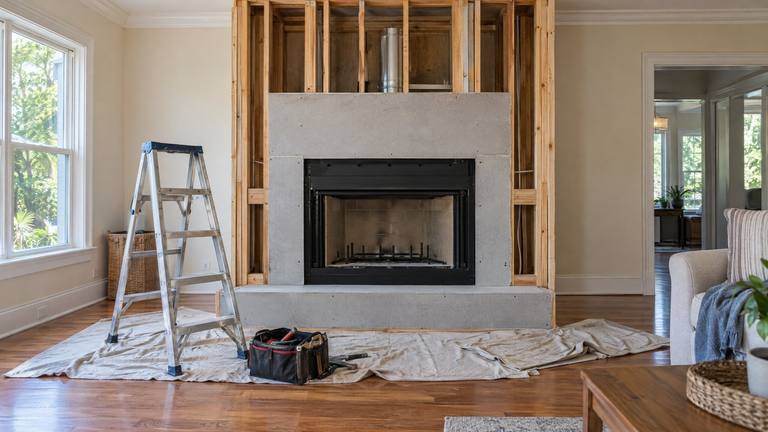
A wood insert in place

Installing a wood insert, start to finish
-
Measure the firebox free
We measure the front width, rear width, height and depth against the insert maker's table before you order.
-
Clean and repair the chimney
The flue is cleaned and the fireplace checked for cracks and loose mortar, and any repairs are made before the insert goes in.
-
Run the liner, set the insert
A UL 1777 stainless liner sized to the insert collar runs full length to a top plate and cap, and the insert is connected and set.
-
Seal the surround, show the controls
The surround panels are sealed to the fireplace face, and we walk you through loading, the air control and the first fires.
10% off any service booked within 72 hours of inspection
Ready for real heat from your fireplace? The insert and its install both take the 10% off.
A wood insert, a gas insert or the open fireplace?
An insert is one of three ways to go, and the fireplace you have decides which ones are open to you.


Liner and parts for a wood insert
- UL 1777 stainless liner
- Sized to the insert's collar and listing and run from the collar to the top of the flue.
- Liner insulation
- A wrap or poured insulation, where the liner or insert listing calls for it to meet its clearance to combustibles.
- Top plate and screened cap
- The top plate closes the old flue around the liner, and a screened cap sits on top against rain and animals.
- Surround panels
- Sized to the fireplace face and sealed at the edges, which keeps room air from slipping into the chimney cavity.
Checked before any wood insert is ordered
- Fireplace and chimney condition, and any repairs needed before the insert goes in
- The insert's listing, its minimum fireplace size and its clearances
- Liner diameter, type and length, from the insert collar to the top of the flue
- Liner insulation where the listing calls for it
- The damper, removed or locked open, and any smoke shelf trimming the manual allows
- Surround panels sized and sealed to the fireplace face
- Top plate, cap, and the mantel, trim and floor protection checks
Wood insert installation questions
How do you know an insert will fit my fireplace?
The insert manual lists minimum firebox dimensions, and before any fireplace insert install we measure yours against them on a free inspection. The numbers go on the estimate.
Why run the liner all the way up?
Insert manuals call for a full liner or a sealed connection into the flue, and a full liner gives steadier draft and easier cleaning. We size it to the insert's collar.
Can the insert go in on one visit?
Usually, once the insert is in hand and the chimney is ready. Any repairs the fireplace needs are scheduled before it.
Is the existing fireplace checked before I order an insert?
Yes. The free inspection helps establish whether the opening and chimney are ready for the proposed insert. Call (904) 920-5495 to arrange that visit before committing to a unit.
Is the insert price quoted in full?
Yes. The liner, insulation, surround, cap and any repairs are all listed, and the total does not change without your say-so.
Why homeowners switch to a wood insert
An open fire that barely warms the room
Open fires draw room air up the chimney. An insert burns slower behind a closed door and releases its heat into the room.
Smoke puffing out at the opening
A large masonry flue drafts poorly for a small fire. An insert on a liner sized to its collar keeps the draft steady.
Burning through wood too fast
An insert burns slower behind a door with an air control. Units made or sold since May 15, 2020 meet the EPA Step 2 limit, checked on the label.
Not sure an insert fits your fireplace
Each insert manual lists a minimum front width, rear width, height and depth. We measure your firebox against it before anything is ordered.
Get your firebox measured for an insert
A local insert professional checks the fireplace and the flue and writes every part and price down before you order.
Free InspectionFull service details
What a wood insert is and the rules it meets
A wood-burning insert is a steel or cast-iron firebox with a door, built to slide into an existing masonry fireplace. The same unit is often sold as a wood stove insert, and its installation follows the same listing rules. Inserts are tested as solid-fuel room heaters under UL 1482, and the listing sets the fireplace sizes, clearances and liner the insert may be used with.
Under the EPA wood heater rule, 40 CFR Part 60 Subpart AAA, heaters made or sold at retail from May 15, 2020 on must meet the Step 2 limit of 2.5 grams per hour with cord wood, or 2.0 with crib wood. We confirm it from the permanent label on the insert.
Preparing the fireplace for an insert
Insert manuals ask for the fireplace to meet NFPA 211 or the local code, to be checked for cracks and loose mortar and repaired before installation, and for the flue to be cleaned of creosote and obstructions and kept free of any other appliance. Each manual also lists a minimum fireplace size, and we measure the opening against it before the insert is ordered.
Liner, damper and surround on an insert install
Manuals allow a full liner from the insert collar to the top of the flue, or a short positive connection with a throat blocker where they permit it. One maker calls the full liner the safest method with the best draft, and that is what we fit, a stainless liner listed to UL 1777, sized to the collar and insulated where the listing requires. For a factory-built fireplace that allows an insert at all, one insert manual requires a full liner meeting the Type HT rating.
The damper is locked open or removed so it cannot close on the liner, and part of the smoke shelf is trimmed only where the manual allows it and the structure is not weakened. The surround is sealed to the face, the listing's clearances to mantel, trim and floor are checked, and a top plate and screened cap close the old flue.
Call (904) 920-5495 to book the free inspection, and bring the insert model if you have one picked.

Wood-Burning Fireplace Insert Installation by Town
- American Beach
- Arlington
- Atlantic Beach
- Avondale
- Baldwin
- Bayard
- Bellair-Meadowbrook Terrace
- Brentwood
- Brooklyn
- Bryceville
- Callahan
- Clay Hill
- Crawford
- Doctors Inlet
- Fernandina Beach
- Fleming Island
- Fruit Cove
- Garden City
- Green Cove Springs
- Hilliard
- Jacksonville Beach
- Julington Creek Plantation
- Keystone Heights
- Kings Ferry
- Lake Asbury
- Lake Geneva
- Lake Shore
- Lakeside
- Mandarin
- Mayport
- Middleburg
- Murray Hill
- Nassau Village-Ratliff
- Nassauville
- Neptune Beach
- Nocatee
- Northside
- O'Neil
- Oakleaf Plantation
- Oceanway
- Orange Park
- Ortega
- Palm Valley
- Panama Park
- Penney Farms
- Ponte Vedra Beach
- Riverside
- San Jose
- San Marco
- Sandalwood
- Sawgrass
- Springfield
- St. Nicholas
- Sunbeam
- Switzerland
- Tallulah-North Shore
- Yulee