
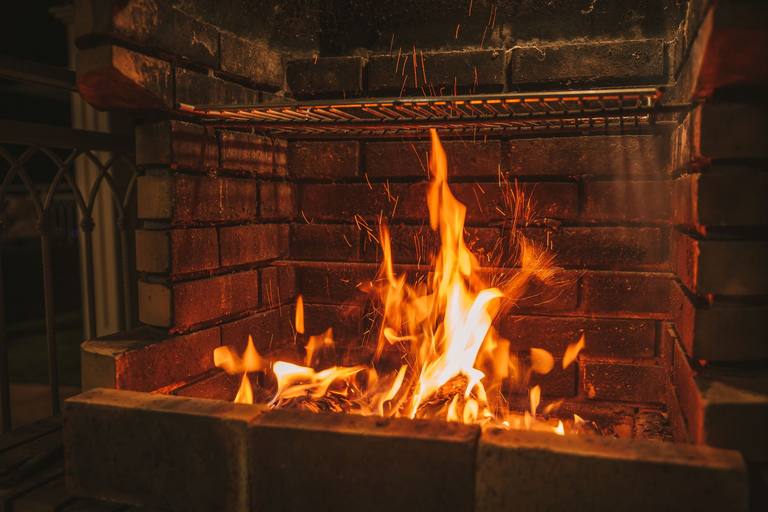
Family-run gas fireplace venting in Bayard
Every vent section fitted in Bayard comes from the appliance's listed system, with no hidden fees.
- Fully licensed and insured
- Locally owned
- Family owned and operated
- Same-day service
Get Your Free Inspection
Get a quote for chimney and fireplace repair and installation in Jacksonville.
Request received
Thank you. We will call you shortly to set a time.
Quicker by phone? Call (904) 920-5495
Venting pros who trace the whole run in Bayard
- Locally owned in Jacksonville
- Family owned and operated
- 100% satisfaction guaranteed
- Free inspection and estimate
- Same-day service available
- 10% off any service
Any new section matches the pipe family the fireplace was approved with.
- Free inspection and estimateThe vent on your Bayard gas fireplace is traced from the collar to the cap and measured against the code at no charge.
- Upfront pricing, no hidden feesEach section, fitting and reroute is priced on its own line before any pipe is cut or replaced.
- 100% satisfaction guaranteedIf the flame, the draft or the shutdown problem is not fixed by the vent repair we quoted, we come back.
Two gas appliances, one vent
Each gas appliance needs its own vent unless its instructions say otherwise. Tying a fireplace into a water heater's vent, or running it up a flue that also serves a wood stove, sets two appliances fighting over one path. Separating them usually means a new vent route for the fireplace alone.
Where we find a shared arrangement, it is written up as a fault along with the separate vent the fireplace needs. Unsure what else shares a vent with your Bayard gas fireplace? Have it traced at (904) 920-5495.
Bayard sits away from the coastline. Bayard is a neighborhood within the City of Jacksonville.
What gas fireplace venting covers in Bayard
- Separated vent joints reseated and locked
- B-vent caps raised to the roof pitch table
- Firestops checked at every reachable penetration
- A flame check after every repair in Bayard
Identify, trace, repair, test
-
Identify the system
The manual and pipe markings tell us the vent type, size and maker.
-
Trace the run
With the unit off and cool, we follow the vent and check joints, supports and clearances.
-
Repair with listed parts
Joints are reseated, damaged sections replaced and crowded caps moved.
-
Test and record
We fire the unit, check flame and draft, then note every fix.
Vent caps well inland
Inland in Bayard, a vent termination wears from debris, nests and settling, not salt. Debris, nests, settling and remodels cause most vent faults.
We check each on the vent visit.
10% off any service booked within 72 hours of inspection
Resealed or rerouted, vent work in Bayard comes 10% off.
Direct-vent caps and operable windows
Table 503.8 of the fuel gas code sets how far a direct-vent terminal must stay from an operable window or door, and the distance grows with the appliance's input: 6 inches for 10,000 Btu per hour or less, 9 inches above that up to 50,000, and 12 inches above 50,000 up to 150,000.
The same table keeps the terminal at least 12 inches above grade. We read the input from the rating plate, measure the cap's position against the table and the maker's diagram, and a cap that falls short is rerouted. The fireplace's input is on its rating plate, which is why we read it first.
How twist-lock joints are made
Much direct-vent pipe joins with a twist lock. One maker's manual has the beads on the male end aligned with the grooves of the female end and the pipe turned until the flange meets the outer pipe. Screws in the joint are optional on that system, and sealant is not required.
The same manual says not to use silicone at the inner flue. A joint turned only partway can look closed and still leak. We check each reachable joint for full engagement and replace a section whose bead or groove is damaged. Screws, where used, go only through the outer pipe.
Two caps and nearby air intakes
Homes with more than one direct-vent appliance can end up with caps close together. One maker's termination rules keep at least 3 feet between termination caps, mechanical air intakes within 10 feet at least 3 feet below a cap, and gravity air intakes within 3 feet at least 1 foot below it.
Those distances stop one appliance from breathing another's exhaust. When a second gas appliance is added, we check the new cap against the old one before the wall is opened. Air intakes for furnaces and dryer vents count as neighbors too.
Clearances, slope and caps on paper
- Air space to framing checked where the pipe passes joists and walls
- Termination measured against Table 503.8 and the maker's chart
- Horizontal runs checked with a level for the maker's rise
- Roof covering work named for a roofer
Gas fireplace vent questions from Bayard
Is B-vent the same as direct vent?
No. B-vent carries exhaust up by natural draft from a unit that burns room air; direct vent is sealed and draws its air from outside. Each fireplace uses the one it was built for.
Why does my flame look blue and lazy?
It is short of air, and a blocked vent is one of the listed causes. Turn the unit off and have the cap and joints checked.
More services in Bayard
-
-
-
-
-
-


Learn more about gas fireplace ventingAll services in Bayard
Set the gas fireplace vent right in Bayard
Our venting pros trace your Bayard vent from collar to cap and write each fix down. Call (904) 920-5495.
Free Inspection