
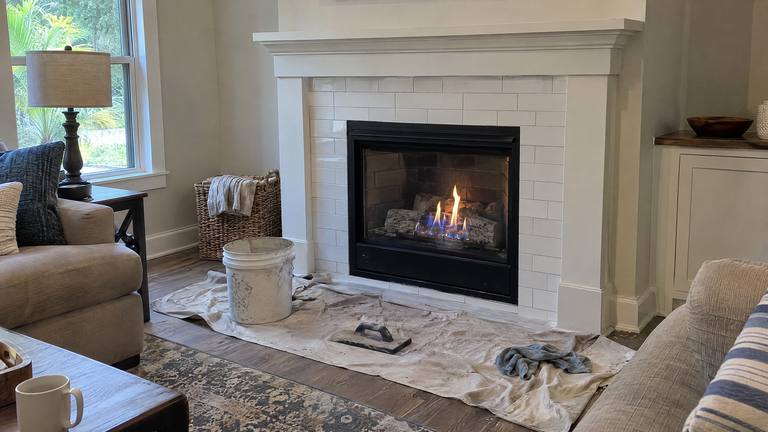
Direct vent fireplace repair in Palm Valley
New B-vent runs in Palm Valley laid out from the maker's height, elbow and roof pitch limits before a hole is cut.
- Fully licensed and insured
- Locally owned
- Family owned and operated
- Same-day service
Get Your Free Inspection
Get a quote for chimney and fireplace repair and installation in Jacksonville.
Request received
Thank you. We will call you shortly to set a time.
Quicker by phone? Call (904) 920-5495
Local vent specialists who repair with listed parts
- Locally owned in Jacksonville
- Family owned and operated
- 100% satisfaction guaranteed
- Free inspection and estimate
- Same-day service available
- 10% off any service
A spill switch is tested, not bypassed.
- Free inspection and estimateThe vent on your Palm Valley gas fireplace is traced from the collar to the cap and measured against the code at no charge.
- Upfront pricing, no hidden feesEach section, fitting and reroute is priced on its own line before any pipe is cut or replaced.
- 100% satisfaction guaranteedIf the flame, the draft or the shutdown problem is not fixed by the vent repair we quoted, we come back.
A vent through a cold chase
Natural-draft vents depend on warm exhaust rising, and a chase that stays cold can slow that down until the fireplace spills or struggles. How the chase is built, and whether it is insulated, is part of the diagnosis. A chase that is warm in winter helps a natural-draft vent start drawing.
Insulation near the pipe still has to keep its distance, so the fix is planned, not improvised. B-vent fireplace in a chase at your Palm Valley house? Ask about the draft at (904) 920-5495.
Palm Valley is part of St. Johns County. The 2020 Census count for Palm Valley was 21,827 people.
Joints, caps, clearances and slope
- Insulation cleared from vent air spaces
- Firestops checked at every reachable penetration
- A flame check after every repair in Palm Valley
- Your Palm Valley vent traced from collar to cap
How gas fireplace vent work runs
-
Identify the system
The manual and pipe markings tell us the vent type, size and maker.
-
Trace the run
With the unit off and cool, we follow the vent and check joints, supports and clearances.
-
Repair with listed parts
Joints are reseated, damaged sections replaced and crowded caps moved.
-
Test and record
We fire the unit, check flame and draft, then note every fix.
Screens near the coast in Palm Valley
A direct-vent unit near the coast in Palm Valley breathes through its cap's screen, and salt narrowing that screen changes the flame.
A lazy flame sends us to the cap first.
10% off any service booked within 72 hours of inspection
Comparing vent quotes? 72 hours gives you time to weigh ours and still save 10%.
Elbows, offsets and the total bend
Every elbow in a vent adds resistance. One maker's direct-vent manual caps the total angular change in a system at 270 degrees and limits how far the pipe may run sideways after an elbow placed right on top of the fireplace to 36 inches.
Its B-vent manual allows at most two 90-degree elbows or four 45-degree elbows per installation, counting two 45s as one 90. When we repair or reroute a vent, the elbows are counted against those limits before anything is added, and a route that would exceed them is redrawn. Every elbow also adds a joint that has to stay tight.
Height limits on a B-vent
Natural-draft vents need height to draw. One maker's B-vent fireplaces need at least 8 feet of vertical vent, measured from the top of the unit to the top of the termination, and allow no more than 40 feet.
The same manual limits any horizontal portion to half the height of the vent system, measured center to center. A short or mostly sideways B-vent drafts poorly and can spill at the draft hood. We measure the system against those figures before repairing it, since a repair that keeps a failing layout keeps the problem. A tall vent can overdraw too, which is why there is a maximum as well as a minimum.
What a vent inspection covers
One maker asks for the appliance and its venting system to be inspected before use and at least annually by a qualified service person, and for the flow of combustion and ventilation air to stay unobstructed.
Our vent inspection starts at the appliance collar and follows the run as far as it can be reached: joints, supports, clearances, firestops and the termination outside. Then the unit runs while we watch the flame and, on natural-vent units, the draft hood. Findings go on the ticket in order along the run. The same inspection covers the draft hood on natural-vent units.
Traced in Palm Valley before any vent pipe is replaced
- Termination measured against Table 503.8 and the maker's chart
- Soffits, corners, meters and air intakes around the cap measured
- Obstructions within 24 inches of the cap noted and cleared
- Elbows counted against the system's limits
Before the vent is opened up
How often should the vent be inspected?
Once a year at minimum, plus a check before first use, by someone qualified. We can put it on the calendar.
Is the vent inspection free?
Yes. The trace and the written quote cost nothing, and the quoted price does not grow. Book the repair within 72 hours of the trace and you save 10% on it.
More services in Palm Valley
-
-
-
-
-
-


Learn more about gas fireplace ventingAll services in Palm Valley
Set the gas fireplace vent right in Palm Valley
Tell us what the flame is doing when you ring (904) 920-5495, and our experts bring the right parts to Palm Valley.
Free Inspection