What moves the price of repointing and brick repair on a chimney
Masonry work is priced by how deep the damage runs, in the joints and in the brick itself.
- Family owned and operated
- Free inspection and estimate
- Same-day service available
- Upfront pricing, no hidden fees
Get Your Free Inspection
Get a quote for chimney and fireplace repair and installation in Jacksonville.
Request received
Thank you. We will call you shortly to set a time.
or call (904) 920-5495
In short
Mortar depth sets chimney tuckpointing cost first: how deep the joints have failed, then how much of the stack needs raking and repointing, whether spalled bricks have to be replaced, how the crew reaches the work, and how closely the new mortar must match the old in type and color. Repointing a few joints on one face is small; a whole stack with brick replacement is large.
Tuckpointing, repointing and masonry repair, sorted
Three names get used for overlapping jobs. Repointing means raking out failed mortar and packing new mortar into the joints. Tuckpointing, strictly, adds a thin contrasting line to make the joints look crisp, though the word is now used loosely for repointing. Masonry repair is the wider job: joints, cracked or spalled brick, and cracks through the stack.
The difference matters for the estimate: chimney repointing cost covers joints alone, while chimney masonry repair cost, or brick chimney repair cost, can cover joints, brick and cracks together. A joints-only job is one kind of work. A job that also replaces brick or chases cracks is several kinds, each listed separately.
From a few joints to a partial rebuild
Holding height and access equal, masonry jobs line up from small to large:
- Repointing a few failed joints on one face.
- Repointing one full face above the roof.
- Repointing every face above the roof, with a color-matched mortar.
- Repointing plus replacing a handful of spalled bricks.
- Repointing plus replacing a band of brick across a face.
- Movement cracks and loose brick across many courses, where the talk turns to a partial rebuild.
How deep the joint failure goes
Mortar fails from the face inward. Sand on the roof, joints that crumble when a key is dragged along them, and gaps where mortar has dropped away are the early signs. Repointing rakes each failed joint back to sound mortar, then packs new mortar in layers so it cures firm against the brick edges.
Shallow failure is quick to rake. Deep failure, where the joint is soft well back from the face, takes more raking and more mortar per joint, and it raises the question of whether the brick is still held tight. Depth is checked in several places on each face before the estimate is written.
How much of the stack needs it
Extent comes next. A few failed joints under a leaking crown are a spot repair. Joints failing across a whole face, or on every face above the roof, make it a full repoint of that area. No fixed line separates the two, so the faces and courses included are listed by name.
One face of a stack can fail well before the others, depending on exposure, runoff from the roof and whether the crown throws water onto it. Repointing only the failed faces is a real option, and it is priced that way when the other faces test sound.
Brick replacement is a second job
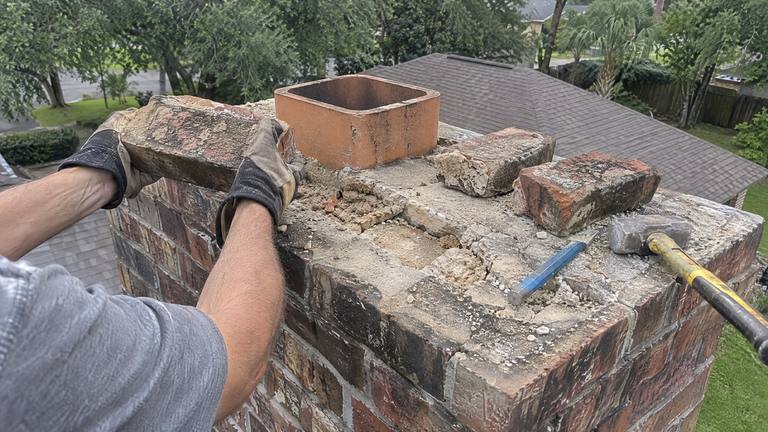
Spalled, cracked or soft brick cannot be fixed with mortar. Each damaged unit is cut out, the cavity is cleaned, and a matching brick is set in fresh mortar. Replacing a handful of bricks is modest work. Replacing a band of them across a face takes more care, since the brick around each opening has to stay tight while units come out.
Matching the brick is part of the scope. Salvaged brick from elsewhere on the property, a close new match, or a new brick toned to blend are the options, and the plan for your stack names one of them.
Matching mortar type and color
ASTM C270 sets four mortar types, M, S, N and O, from strongest to weakest, specified either by proportion or by measured property. Repair mortar is chosen to work with the brick and the old mortar around it. A mortar much harder than the brick can push damage into the brick faces instead of the joints, the opposite of what a joint is for.
Color is the visible half. Matching sand, cement shade and any pigment to weathered joints takes test panels that cure before the choice is made. A color-matched repoint across a whole face takes more time than a patch that makes no attempt to blend, and your quote should make clear which one you are paying for.
Cracks that point to movement
Not every crack is a mortar problem. A stair-step crack through the joints, a crack that runs through brick and mortar alike, or a chimney that has opened a gap against the house wall can mean the stack has moved. Filling it with mortar treats only the symptom.
Movement cracks are traced before they are priced. An old, stable crack is ordinary masonry work. An active crack, or a stack that leans, turns the repair question into a rebuild question, and that change should be spelled out in plain words.
Stone chimneys and stucco finishes
Stone stacks raise the same questions, with more fitting. Stones are irregular, joints are wider and deeper, and matching the mortar's color and texture to old stonework takes care. A loose stone is reset rather than replaced wherever it can be.
A chimney finished in stucco over masonry is a separate repair, since the finish coat has to be matched and the masonry under it judged first. The estimate keeps it apart from the repointing.
Height, access and the crown above
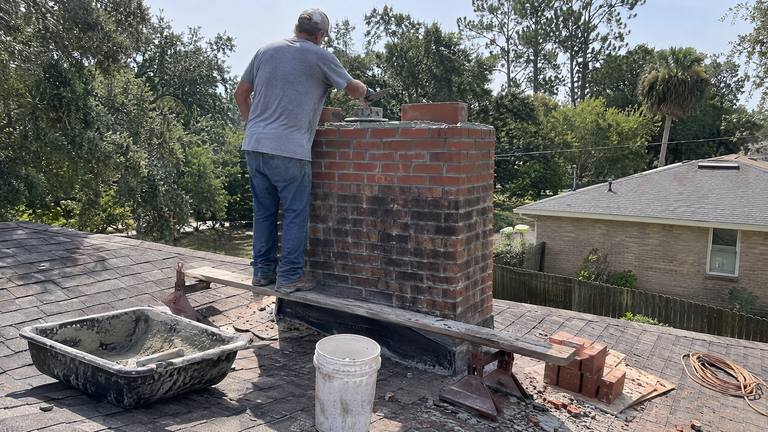
Masonry work happens face by face, from ladders, roof brackets or scaffolding. A tall stack or a steep pitch adds setup to every face, and faces over a lower roof, a porch or a driveway each need separate staging. The crown sits over all of it. Repointing below a cracked crown lets the same water back into the new joints, so crown work may be quoted alongside the repointing.
The one place where waiting changes the scope
Joint repair is the lighter job while the brick is still sound. Once water sits in open joints, the brick faces around them start to spall, and a joints-only job turns into a joints-and-brick job. The estimate marks which faces are close to that point, so you know which part of the work has a clock on it.
What a masonry estimate should list
Look for the faces and courses to be repointed, the joint depth planned, the mortar type and how its color will be matched, the number and location of bricks to replace, any crack repair and its cause, the staging, and the cleanup of mortar smears from the brick faces. Two estimates that list different faces are pricing different jobs.
Ask how the new joints are cured as well. Mortar packed against dry brick can lose its water too fast, so the brick is dampened ahead of pointing and the joints are kept from drying too quickly, following the mortar maker's directions.
FAQ
Frequently asked questions
How can I tell if my chimney needs repointing?
Look for sand or mortar crumbs on the roof, joints sunk well behind the brick face, or joints you can scrape with a key. A stain on the inside wall near the chimney can also point to open joints. A close look from a ladder shows how deep the failure goes.
Can new mortar be smeared over the old joints?
Mortar laid over a failed joint without raking it out has nothing sound to grip. It tends to crack away before long and can trap water behind it, so the old mortar comes out to a sound depth first. Raking is done with hand tools or a grinder guided along the joint, with care so the brick edges are not chipped.
Why not use the strongest mortar available?
In a brick wall, the mortar is the piece designed to give way first. Mortar harder than the brick sends stress and water into the brick instead, and the brick faces start to spall. ASTM C270 lets the type be chosen to suit the masonry.
Will repointed joints match the old ones?
They can come close. Matching sand color, cement shade and joint profile takes test batches, and new mortar lightens as it cures. Whether color matching is included is written on the estimate.
Does repointing keep water out of the chimney?
It closes the joints, a direct path for water into a masonry chimney. It does not fix a cracked crown, failed flashing or an open flue, so a leak with more than one source needs each one closed.

Proudly American
Family owned and operated, from the first call to the final walk-through.
Our Services
Related services
Guides
Chimney and fireplace guides
-
-
-


Get a free chimney inspection
Call or send the form. The inspection is free and the price is written down before any work.
Free Inspection