Where the teardown stops decides the size of a rebuild
A rebuild is counted in courses of brick. The deeper the sound masonry sits, the bigger the job becomes.
- Family owned and operated
- Free inspection and estimate
- Same-day service available
- Upfront pricing, no hidden fees
Get Your Free Inspection
Get a quote for chimney and fireplace repair and installation in Jacksonville.
Request received
Thank you. We will call you shortly to set a time.
or call (904) 920-5495
In short
How many courses of brick come down before the crew reaches sound masonry decides chimney rebuild cost. A partial rebuild above the roofline is the smaller scope; a full rebuild to the firebox or the footing is the largest. Roof access, brick matching, the new crown and flashing, the flue or liner decision and the permit then move the number.
Partial or full: where the teardown stops
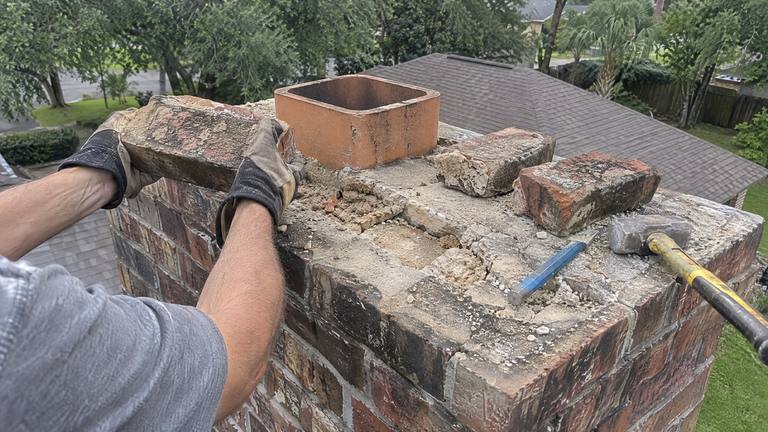
A rebuild takes the chimney down to masonry that is solid and lays it back up from there. Exposure is greatest above the roof, where every face of the brick takes sun and rain, so a partial rebuild stops at a sound course at or near the roofline. A full rebuild goes further, to the smoke chamber, the firebox or the footing. It follows movement, a lean, or deep failure below the roof, and it reaches inside the house as well as onto the roof.
From a few courses to the footing
From the least masonry to the most, rebuild jobs compare like this:
- Relaying a few loose top courses under a new crown.
- Taking a short, single-flue stack down to the roofline and relaying it.
- The same partial rebuild on a tall or multi-flue stack.
- A teardown that runs below the roofline, with flashing and roofing tied back in around it.
- Any partial rebuild combined with a new listed liner.
- Rebuilding all the way to the firebox or the footing.
What can move a job along that list
Access and brick matching can move a job one step up or down. The flue decision can move it further, since a new liner adds material and labor on top of the masonry.
Going all the way down also brings inside work: protecting the room, opening the wall or ceiling where the chimney passes through, and closing it back up. Finishing those surfaces after the masonry is done can belong to another trade, and the estimate lists which of those parts are included.
Counting the courses
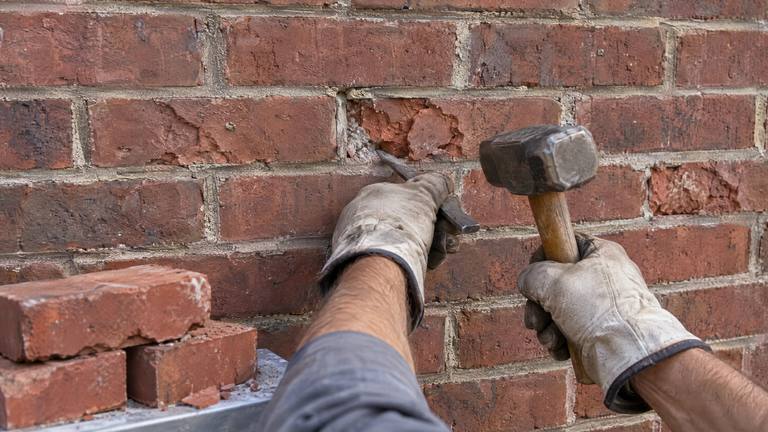
Rebuilds are counted in courses, the rows of brick, and the cost to rebuild a chimney follows that count. Each course down means more brick to remove and clean or replace, more mortar, and more height to lay back up. The estimate names the course where the crew expects to stop, and why, based on what a hand and a hammer find at the top of the stack.
The stop line can move once work starts, because loose brick can run deeper than it looks from the surface. A sound estimate says in advance how that is handled: the finding is shown to you, and the extra courses are priced before they come down.
Brick size matters here too. Older brick can differ in size from brick made today, so relaying to line up with the existing courses takes planning, and the estimate notes when brick has to be matched rather than bought from stock.
Getting brick, mortar and people onto the roof
A rebuild moves a lot of weight up and down the roof. Old brick and rubble come down; new brick, mortar, forms and tools go up. How that happens depends on the house, from a ladder hoist on a low one-story roof to scaffolding beside a tall stack.
The roof around the chimney has to be protected from falling debris, and a tile roof needs more protection than a shingle one. Hauling and disposing of the rubble is part of the work and belongs on the estimate by name.
Matching the brick you keep
At the stop line, new work meets old brick, and it should look as if it belongs. Salvaged brick from the teardown goes back in where it is sound, which helps the match. Where new brick is needed, finding a close match in size, color and texture can take a few samples.
Mortar is matched as well. ASTM C270 defines mortar types by proportion or by property, and the new mortar is chosen to suit the existing brick, not to be as hard as possible. The color is checked with test batches before the stack goes up.
Crown, flashing and the flue decision
A rebuilt stack gets a new crown built to FBC Residential R1003.9.1: sloped, with a drip edge, and with a bond break separating it from each flue. The flashing is renewed as the courses pass back through the roofline, with the counter flashing let into the new mortar joints.
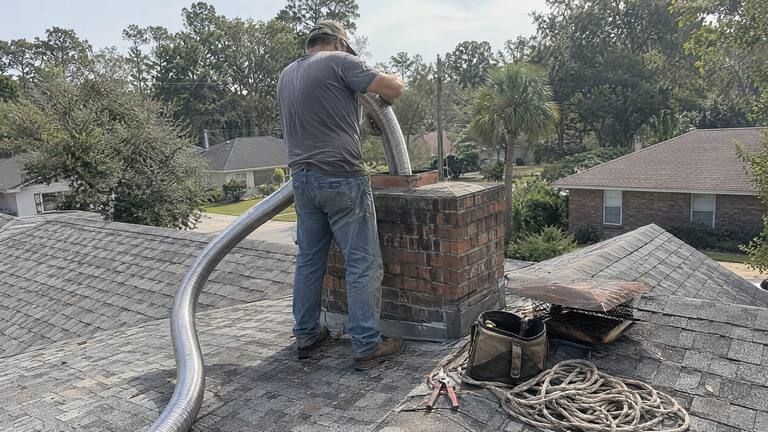
The flue decision comes at the same time. Clay flue tile can be set in refractory mortar as the courses rise, as R1003.12 describes, or the stack can be rebuilt around a new listed liner. The choice depends on the appliance and on the condition of the tile below the stop line, and it tends to be among the larger lines on a rebuild estimate.
Smoke chamber and firebox work can join a full rebuild, since both sit inside the masonry being relaid. Parging the smoke chamber smooth or relining the firebox with firebrick is easier while the stack is open, and each is itemized.
When the stack has moved
Any chimney that leans or has pulled away from the house is a structural finding, not only a masonry one. The cause can sit in the footing, in a failed connection to the framing, or in mortar washed out low in the stack. A rebuild that skips the cause can lean again.
So the estimate names the likely cause, and where the footing is in doubt, it says whether an engineer's opinion is needed before any brick comes down. That opinion is a separate cost, and it can change the scope in either direction.
Height and the permit
A rebuilt chimney has to meet the termination height in FBC Residential R1003.9: its top clears the roof by 3 feet or more, measured from the high side of the roof penetration, and stands 2 feet or more above any portion of the building that lies within 10 feet. A rebuild is the natural moment to correct a stack that fell short, so height can add courses.
A rebuild changes the structure, and Florida law requires a permit to alter or repair a building unless an exemption applies (F.S. 553.79). The building department issues it and inspects the work, and the schedule on the estimate shows where those inspection visits fall and who files the application.
What a rebuild estimate should show
A chimney rebuild price means little without its lines. Look for the planned stop line and how a deeper stop will be handled, the brick and mortar choice, the crown and flashing, the flue or liner, debris removal, roof protection and the permit. Each deserves a separate entry.
Before agreeing to a rebuild, ask what makes a repair the wrong answer for this stack. A lean, loose brick across many courses, or water damage that runs deep into the masonry, are the findings that point to rebuilding.
FAQ
Frequently asked questions
How much time does a rebuild take?
That depends on how many courses come down, the weather and the permit inspections. A partial rebuild above the roof is a shorter job than a full rebuild, which also has inspection visits and cure time built in. The estimate gives a schedule once the scope is set.
Can the rebuild reuse the old brick?
Sound brick that comes off cleanly can go back in, and reusing it helps the new work match. Spalled, cracked or soft brick is replaced. Reused brick is cleaned of old mortar first so the new joints can grip it.
Can I use the fireplace while the chimney is being rebuilt?
No. The flue is open or under construction for the length of the job. No fires until the new masonry has cured and the flue is complete.
Is the roof repaired as part of the rebuild?
The flashing and the roofing directly around the chimney are tied back in during the rebuild. Damage beyond that, such as rotted sheathing or a worn-out covering, belongs to a roofer, and the estimate shows where one trade stops and the other starts.
Why would the rebuilt chimney be taller than the old one?
The residential code (R1003.9) sets a minimum height above the roof and above anything within 10 feet. If the old stack fell short, the rebuild is the chance to bring it up to that height.

Proudly American
A family business that answers its own phone.
Our Services
Related services
Guides
Chimney and fireplace guides
-
-
-


Book your free inspection
Call or send the form. The inspection is free and the price is written down before any work.
Free Inspection