
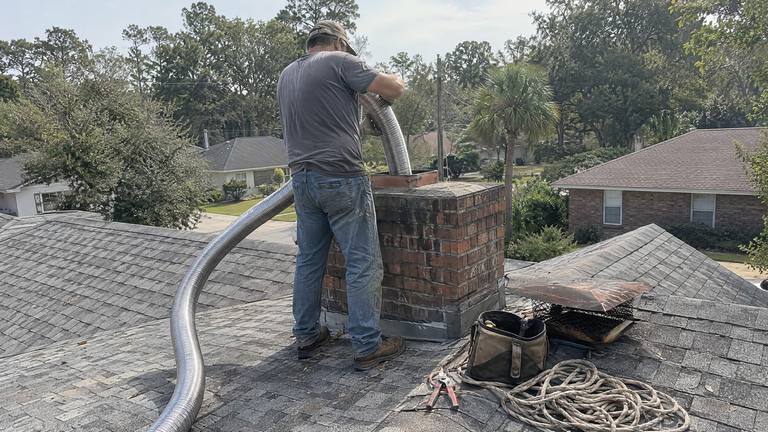
Local chimney liner installation for Palm Valley homes
What a liner fixes, and what it does not, is explained on a free inspection before any relining work in Palm Valley begins.
- Fully licensed and insured
- Locally owned
- Family owned and operated
- Same-day service
Get Your Free Inspection
Get a quote for chimney and fireplace repair and installation in Jacksonville.
Request received
Thank you. We will call you shortly to set a time.
Quicker by phone? Call (904) 920-5495
Chimney liner specialists who prove the flue first
- Locally owned in Jacksonville
- Family owned and operated
- 100% satisfaction guaranteed
- Free inspection and estimate
- Same-day service available
- 10% off any service
We read the liner's listing and follow it from the tee at the bottom to the cap at the top.
- Free inspection and estimateWe sweep and measure the flue in Palm Valley at no charge before any liner is ordered.
- Upfront pricing, no hidden feesLiner size, alloy, insulation and cap are one written price, set before the order goes in.
- Workmanship warrantyHow we install the liner is covered by our workmanship warranty, and the maker's terms come in writing.
What the relining estimate lists
Each part of the job gets its own line, so you can see what is being bought and why. Expect the liner's diameter and length, its alloy and whether it is rigid or flexible, the insulation and how it is applied, the bottom connection, the top plate and cap, and the sweep that goes first.
Anything outside the liner itself, such as crown repair, broken tile removal or a new wall thimble, is listed separately with its reason. The estimate also notes whether the job needs a permit and who applies for it, so nothing about the Palm Valley job turns up as a surprise halfway through. Measuring is free in Palm Valley; call (904) 920-5495 and have the appliance model handy.
Palm Valley falls within St. Johns County. Palm Valley had 21,827 residents at the 2020 Census.
A liner job from sweep to cap
- Old flue swept clean before anything goes in
- Rigid sections or flexible liner chosen for the flue's path
- Broken tile cleared out of the liner's way
- Crown under the top plate checked on your Palm Valley chimney
How chimney relining runs
-
Sweep and prove the flue
The flue is swept clean, then a test piece or cone is lowered to make sure the liner will pass every bend.
-
Size and alloy chosen
The diameter comes from the appliance collar or the fireplace opening, and the alloy from the fuel.
-
Liner run down and joined
The liner goes down with its insulation where the listing asks, and joins the stove, insert or smoke chamber below.
-
Top plate, cap and record
The top plate is clamped and sealed, the cap fastened, and you get the installation record.
Crown cracks under a new top plate
Near the coast, crowns crack from years of wind and rain. A top plate sealed onto a cracked crown still lets water into the masonry around the liner.
When relining a chimney in Palm Valley, the crown condition goes on the estimate before any liner is ordered.
10% off any service booked within 72 hours of inspection
Relining is a larger job, and it earns the discount just as a sweep does.
Why the flue is swept before relining
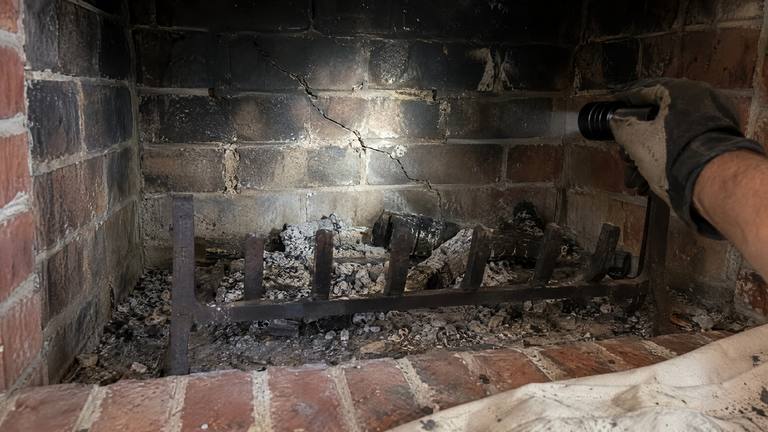
Liner makers call for the chimney and the smoke chamber to be cleaned thoroughly before their product goes in. Old creosote left in the flue becomes fuel sitting around the new liner, in a space nobody will be able to reach again.
The sweep also exposes the tile and joints for a last look, and it clears the smoke chamber so the bottom connection can be seen and fitted properly. It is the first line of the relining estimate, done on the same visit as the installation or just before it. A sweep also shows whether any glaze needs removal before the liner goes in.
Where the wall opening for a stove goes
When a stove connects through the side of the chimney, the opening in the masonry has to hold the connector firmly and keep the required clearance to any wood around it. Liner makers also ask that the opening not be placed directly behind the appliance, so the connection can be reached for inspection and cleaning.
If an old opening sits at the wrong height for the new stove, too close to framing, or behind where the stove will stand, a new opening is made and the old one closed with masonry. That work is priced separately from the liner.
Chimney height and the liner listing
Liner systems are listed for a range of chimney heights, and one maker's instructions call for a chimney at least 10 feet high. Below that, the draft a liner can produce may not be enough for the appliance.
The code sets its own height rule at the roof: at least 3 feet above where the chimney passes through, and 2 feet above anything on the building inside a 10-foot radius (FBC R1003.9). Where the chimney meets neither rule, a liner alone does not fix it. A short chimney is pointed out before any liner is priced.
Measured before a liner is ordered in Palm Valley
- Flue proved with a test piece or guide cone before ordering
- Stainless alloy picked from the listing for the fuel being burned
- Wall thimble checked for fit and clearance where the connector enters
- Sweep of the old flue and smoke chamber before installation starts
Before a liner is ordered
Do you install chimney liners in Palm Valley?
We do. Describe the fireplace or stove and the reason relining came up, and the Palm Valley estimate visit is planned around it.
What paperwork do I get after relining?
The liner maker's instructions and an installation record with the liner size, alloy, length and insulation. Keep them with the house papers for the next sweep, inspection or sale.
More services in Palm Valley
-
-
-
-
-
-


Learn more about chimney liner installation and reliningAll services in Palm Valley
Measure your Palm Valley flue for a liner
A family-owned team of relining professionals sweeps and measures your Palm Valley flue for free.
Free Inspection