
Chimney waterproofing in Palm Valley by local experts
Treatment in Palm Valley scheduled for the weather the data sheet asks for, planned on a free inspection with no rush to beat a storm.
- Fully licensed and insured
- Locally owned
- Family owned and operated
- Same-day service
Get Your Free Inspection
Get a quote for chimney and fireplace repair and installation in Jacksonville.
Request received
Thank you. We will call you shortly to set a time.
Quicker by phone? Call (904) 920-5495
Chimney waterproofing specialists who test before spraying
- Locally owned in Jacksonville
- Family owned and operated
- 100% satisfaction guaranteed
- Free inspection and estimate
- Same-day service available
- 10% off any service
Film sealers and paint trap water in brick, which is why they stay off the chimneys we treat.
- Free inspection and estimateWe splash test your Palm Valley chimney at no charge and tell you if the brick needs treatment at all.
- No hidden feesRepairs and repellent are separate lines, and nothing is added once the spraying starts.
- 100% satisfaction guaranteedIf treated brick still soaks up water where we sprayed, we come back and put it right.
Why the crown and flashing come first
The top of the stack and the roof line are two of the ways water gets into a chimney, besides its faces. The crown sheds rain from the top of the chimney, and the flashing closes the seam where the roof meets the chimney.
If either has failed, water runs into the masonry faster than any treatment could keep out. So when we find a cracked crown or loose flashing on your chimney in Palm Valley, those repairs come ahead of any repellent, and the treatment is scheduled after they are done. A repellent over a failed crown is money spent on the wrong part. Damp patches on the chimney in Palm Valley? Call (904) 920-5495 and we will test the brick.
Palm Valley is in St. Johns County. The 2020 Census count for Palm Valley was 21,827 people.
Waterproofing work we do in Palm Valley
- Cure time after repointing taken from the data sheet
- Brick cleaned so the repellent reaches the pores
- Test patch left to dry beside untreated brick
- Breathable silane or siloxane repellent, product named
How chimney waterproofing runs
-
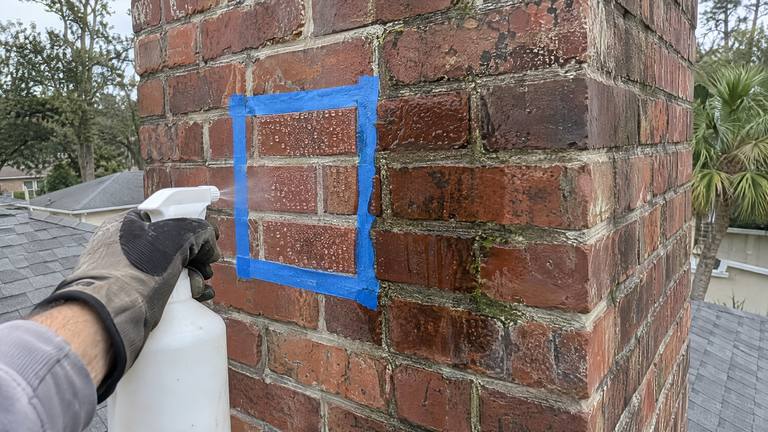
Splash test every face
Water on each face shows where the brick soaks it up, and the crown, cap and flashing are checked for openings.
-
Openings closed and cured
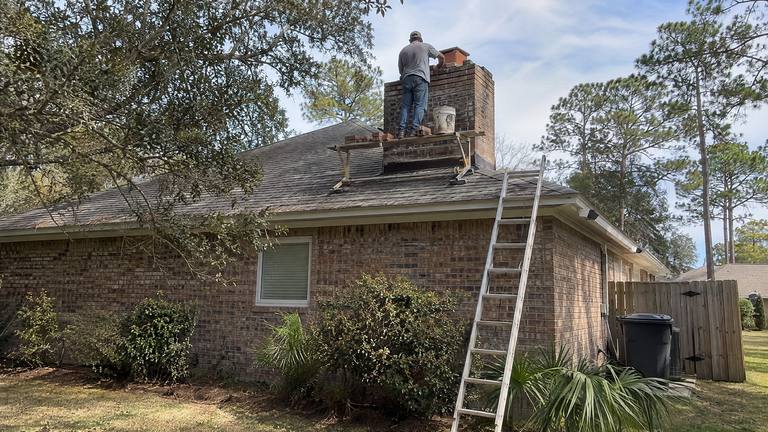
Joints, brick, crown and flashing are repaired first, and the cure time on the data sheet runs its course.
-
Clean, patch test, then flood
The brick is cleaned, a test patch dries beside untreated brick, then the repellent goes on from the bottom up.
-
Dry and retest
Once it has cured, we splash the faces again so you can see the water bead off.
Old sealers near the coast in Palm Valley
Chimneys close to the ocean often carry old coatings put on to keep salt out. Many have gone cloudy or started to peel, and a new repellent will not soak through them.
We test the old coating in Palm Valley, and we report whether it must come off first.
10% off any service booked within 72 hours of inspection
Repairs and treatment together, waterproofing your Palm Valley chimney is 10% off.
The crack width a repellent will not bridge
A penetrating treatment lines the pores of the masonry; it does not fill a gap. BIA's clear-coatings note draws the line precisely, saying these products seldom keep water out of cracks more than 0.02 inch wide. That is about half a millimeter, roughly the thickness of five sheets of printer paper stacked together.
Wider openings, such as an open head joint, a cracked brick or a separation under the crown, pass water straight by the treated surface around them. Those are fixed with mortar or new units first. The treatment, if it still makes sense, comes once the wall is closed.
How a film sealer holds water in brick
Clear products that sit on top of the brick, such as acrylics, stearates, waxes and urethanes, dry into a continuous skin. The skin can span a hairline crack, which sounds like an advantage, but it also chokes the vapor that has to leave the wall when it dries. On a chimney, water arrives from above, from the flue side and through joints as well as through the faces.
If that water cannot escape outward at its normal pace, it stays in the brick longer, and BIA warns that salts can collect under such a skin and harm the face. For that reason we do not use film sealers on chimney masonry.
Visibly dry brick and a rain-free window
For a penetrating product to soak in, the pores need to have room for it. The maker's directions call for clean, structurally sound masonry that is visibly dry, and they rule out wet or saturated surfaces. They also ask for a six-hour window with no rain expected, unless the treated wall can be sheeted with plastic. After a run of wet days, brick can look dry at the face while still holding water further in, so on the day we check the brick itself, pressing and looking at freshly scraped mortar, rather than relying on the forecast and the look of the surface alone.
Tested before any repellent goes on in Palm Valley
- Splash test of each face to show where the brick absorbs water
- Weather window: dry masonry, no rain forecast, temperature in range
- Clean-up of overspray on nearby surfaces the same day
- Stucco or stone areas, and the product listing that covers them
Before any sealer goes on
Can the treatment be done the same day as repointing?
No. Fresh joints need at least 72 hours to cure first, according to BIA and the product's data sheet, so treatment is a second visit.
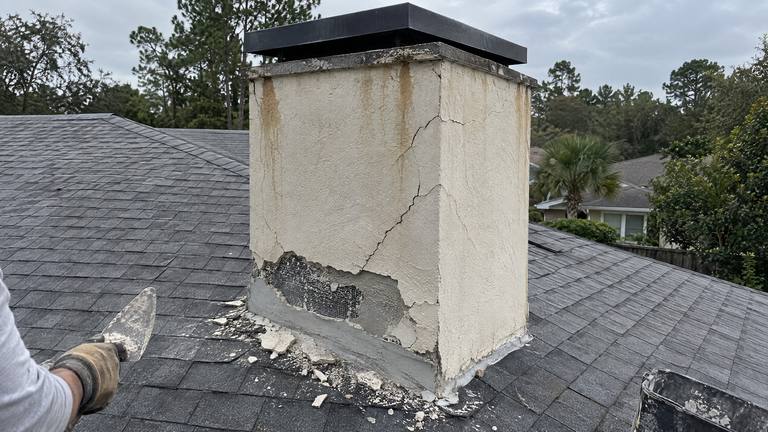
Can you treat a stucco chimney?
The product we use lists portland cement stucco among its surfaces. Cracks in the stucco are repaired first, and a test patch shows how it takes the product.
More services in Palm Valley
-
-
-
-
-
-


Learn more about chimney waterproofingAll services in Palm Valley
Find out if your Palm Valley brick needs sealing
Family-owned masonry professionals check whether your brick in Palm Valley needs treatment at all. The test is free.
Free Inspection