
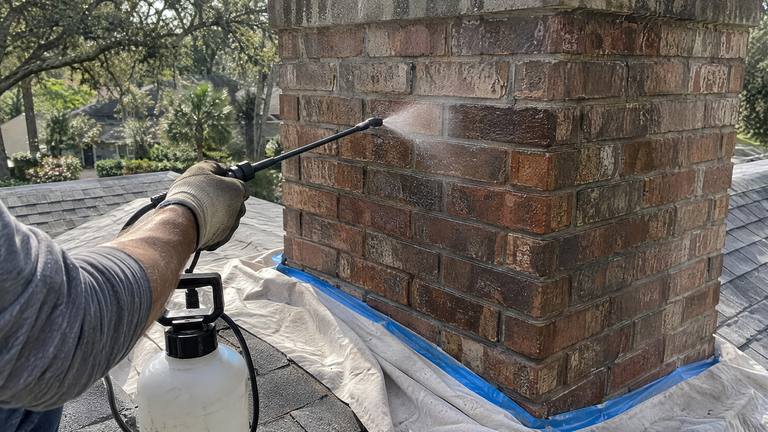
Local chimney waterproofing for Lakeside homes
Plain advice from a free inspection in Lakeside, and when the repairs alone have solved the water problem, we say so.
- Fully licensed and insured
- Locally owned
- Family owned and operated
- Same-day service
Get Your Free Inspection
Get a quote for chimney and fireplace repair and installation in Jacksonville.
Request received
Thank you. We will call you shortly to set a time.
Quicker by phone? Call (904) 920-5495
Local waterproofing experts for Lakeside brick
- Locally owned in Jacksonville
- Family owned and operated
- 100% satisfaction guaranteed
- Free inspection and estimate
- Same-day service available
- 10% off any service
A splash test shows which faces drink water, and those are the faces we treat.
- Free inspection and estimateWe splash test your Lakeside chimney at no charge and tell you if the brick needs treatment at all.
- No hidden feesRepairs and repellent are separate lines, and nothing is added once the spraying starts.
- 100% satisfaction guaranteedIf treated brick still soaks up water where we sprayed, we come back and put it right.
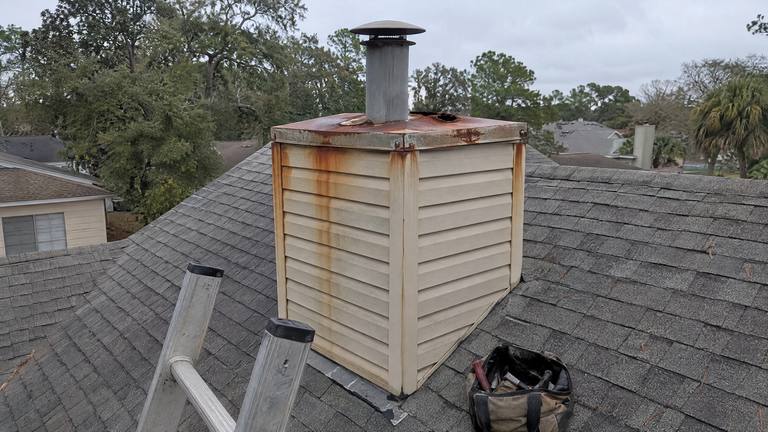
A framed chase is not brick
Framed boxes finished in siding or stucco, built around a metal chimney from a fireplace maker, are not masonry, and masonry repellents are made for brick, stone and concrete rather than for siding or the metal on top of a chase. For your house in Lakeside with a framed chase, water problems are traced to the chase cover, the storm collar, the siding and the trim around it. If the chase is finished in stucco, the stucco is checked for cracks and treated only where its product sheet allows. The repair described is the right one for the material you actually have. Not every Lakeside chimney needs a repellent; the free inspection tells you, so call (904) 920-5495.
Lakeside falls within Clay County. In the 2020 Census, Lakeside counted 31,275 residents.
Test, repair, then treat
- Splash test on every face to see where brick drinks
- Cure time after repointing taken from the data sheet
- Old film sealer tested and removed where it blocks treatment
- Flood coat applied from the bottom up
How our waterproofing specialists treat a chimney in Lakeside
-
Splash test every face
Water on each face shows where the brick soaks it up, and the crown, cap and flashing are checked for openings.
-
Openings closed and cured
Joints, brick, crown and flashing are repaired first, and the cure time on the data sheet runs its course.
-
Clean, patch test, then flood
The brick is cleaned, a test patch dries beside untreated brick, then the repellent goes on from the bottom up.
-
Dry and retest
Once it has cured, we splash the faces again so you can see the water bead off.
Painted chimneys in Lakeside
The repellent we use is not made for painted or glazed brick, since paint already forms a film on the face. Spraying over it does nothing useful.
For a painted chimney in Lakeside, we talk through the options for the paint before any treatment is priced.
10% off any service booked within 72 hours of inspection
Repairs and treatment together, waterproofing your Lakeside chimney is 10% off.
Old sealer on the brick
Sealer applied in the past may still be on the brick, and a new treatment has to work with it or replace it. According to BIA, penetrating repellents are typically incompatible with film-forming coatings already on the brick, and putting one over the other can lead to clouding or poor penetration. Signs of an old film include a gloss, a whitish haze or patches that have peeled away. When we see those, a small test tells us more, and removal is listed as its own step, done to the old product maker's directions and with the removal products disposed of properly.
Painted or glazed brick is left out
The maker's directions for the repellent we apply exclude painted brick and glazed brick or tile. Paint already forms a film on the face, and a glazed unit has a fired, glass-like surface that the product cannot enter. Spraying either one wastes material and can leave a haze. Painted or glazed sections of a chimney are therefore masked off and left untreated. If paint on the chimney is blistering, peeling or taking the brick face with it, that points to moisture trapped behind it, and what to do about the paint is set out as a separate decision.
What the treated brick looks like
Once cured, a penetrating treatment is meant to leave the chimney looking much as it did before. The product's own literature describes little or no gloss and no change to natural color or texture, while noting that dense surfaces can darken slightly and that existing stains may become more visible. BIA adds that a noticeable sheen after treatment can mean the wrong product or poor application. The trial area is therefore judged dry, in daylight, from the ground as well as up close, and compared with untreated brick next to it before the rest of the stack is done.
Tested before any repellent goes on in Lakeside
- Faces treated, and surfaces left out such as the crown top
- Efflorescence brushed off dry, with its water source dealt with first
- Clean-up of overspray on nearby surfaces the same day
- Stucco or stone areas, and the product listing that covers them
Before any sealer goes on
Can the treatment be done the same day as repointing?
No. Fresh joints need at least 72 hours to cure first, according to BIA and the product's data sheet, so treatment is a second visit.
Does the repellent change the color of the brick?
The product we use leaves little or no shine, though very dense brick can go a shade darker. You see the trial patch dry, next to untreated brick, before the rest is done.
More services in Lakeside
-
-
-
-
-
-


Learn more about chimney waterproofingAll services in Lakeside
Brick that sheds rain in Lakeside
Family-owned masonry professionals check whether your brick in Lakeside needs treatment at all. The test is free.
Free Inspection