Vented or vent-free logs: look, heat, damper and room size
Two standards, two sets of rules, and what each means for your fireplace.
- Family owned and operated
- Free inspection and estimate
- Same-day service available
- Upfront pricing, no hidden fees
Get Your Free Inspection
Get a quote for chimney and fireplace repair and installation in Jacksonville.
Request received
Thank you. We will call you shortly to set a time.
or call (904) 920-5495
In short
Gas logs vented vs ventless trade looks against heat. Vented sets burn tall yellow flames, need a working chimney with the damper fixed open, and lose heat up the flue with their exhaust. Vent-free sets burn smaller flames kept off the logs, keep their heat in the room, and must fit the room-size and location limits in the Fuel Gas code.
Two appliances that look alike in the box
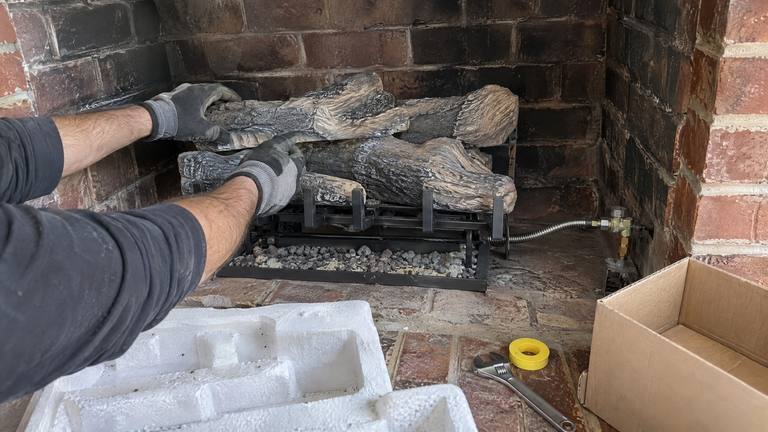
The vented vs vent-free gas logs choice starts with what the two share. Both kinds are a burner, a grate and a set of ceramic logs made to sit in an existing wood-burning fireplace. They are tested to different standards and follow different rules.
The vented kind is a decorative appliance meant for a solid-fuel fireplace and carries an ANSI Z21.60 listing; section 602.1 of the Fuel Gas volume makes that listing a requirement, with ANSI Z21.84 as the alternative for a natural gas set lit by hand. The vent-free kind counts, under the code, as an unvented room heater, and it carries an ANSI Z21.11.2 listing under section 621.
Where they may go differs too. A vented set needs a working masonry or listed fireplace with a chimney. A vent-free set can go into a masonry fireplace, into a listed ventless firebox enclosure, or into a factory-built fireplace only when that fireplace carries a listing for it, under section 621.7 and residential code section R1004.4.
How each one looks when lit
Vented sets are built for the look of a wood fire. One vented set's manual states that the appliance is designed to burn with yellow flames, and those flames can rise tall and wrap around the logs, the way a wood fire does. Their exhaust leaves through the chimney, so a flame that touches the logs is part of the design.
Vent-free sets are built to burn cleanly in the room, and that shapes the flame. The burner keeps the flame away from the logs, and the logs are pinned in an exact layout. One vent-free manual warns that yellow flames contacting the logs will create soot and tells owners to reposition any log the flame touches. The result is a smaller, bluer flame with yellow tips, and a set that looks tidier but less like a log fire.
Heat
By its listing, a vented set is decorative. Its exhaust has to leave through the chimney, and heat goes with it, so the room gets the glow and some radiant warmth from the front of the fire. As a room heater, a vent-free set keeps its heat in the room, and vent-free sets can include a thermostat that cycles the burner to hold a set temperature.
The trade is that everything a vent-free set produces stays in the room too, so the code sizes it against the room's volume, and the room takes on its moisture.
The damper
A vented set needs the damper open whenever it runs, and the manuals go further: they come with a damper clamp that stays on for good, holding a minimum open area that the manual tables by burner size. Where the clamp will not fit, the fallback is a fixed stop, taking the blade out, or trimming the damper so it stops short of that opening.
A vent-free set can run with the damper closed in some cases. One listed vent-free set may be operated that way, provided noncombustible material of the thickness and height its manual gives sits above the opening and the mantel clearances are met. Short of those, the set has to be run vented, damper clamped open and thermostat left off, per that manual. The same manual requires any outside air ducts or ash clean-out openings in the firebox to be permanently closed.
Room size, location and moisture
Vent-free sets carry rules vented sets do not. The Fuel Gas volume caps an unvented room heater at 40,000 Btu per hour, holds the combined unvented input in a space to 20 Btu an hour per cubic foot, and does not let the unit serve as the home's sole comfort heat (section 621). Bedrooms and bathrooms are off limits under section 303.3, apart from one small wall-mounted heater with oxygen depletion protection.
One vent-free manual estimates the water it adds at close to an ounce an hour per 1,000 Btu of input and warns of mildew in a room short of ventilation air. That manual also points out that vent-free heaters are banned in some states and localities, and a companion log set manual names candles and fans aimed at the flame as sources of soot. A vented set has no room-size rule, but it has a minimum firebox size and, in one maker's tables, a minimum chimney height.
Upkeep and service
Both kinds, by their manuals, get a technician's check when new and yearly from then on. A vented set also depends on the chimney staying clear and capped, and on the damper clamp staying in place. A vent-free set depends on its oxygen depletion sensing pilot staying clean and its logs staying exactly where they belong. On either set, soot on the logs means stopping and calling for service; it is not a cosmetic issue.
Glass doors, screens and what goes on the burner
Glass fireplace doors stay fully open whenever either kind of set is burning, according to their manuals, and a fireplace screen stays in place. One vented set's manual adds that a door frame blocking air at the fireplace floor needs slots, and that the doors, once opened, must still leave the set's minimum opening clear.
Only the parts supplied with the set go on the burner. Manuals for both kinds warn against adding logs, pine cones or decorative rock beyond what the set came with, because extra material in the flame is a named cause of soot.
Ventless gas logs pros and cons, set against vented
Set next to each other, the two kinds come out like this.
- Vented: the flame closest to a wood fire, no room-size rule and no combustion products in the room; the damper is fixed open, heat goes up the chimney, and the chimney has to be sound and clear.
- Vent-free: real heat into the room, thermostat control where the set includes it and no need for an open damper when its clearances are met; strict room-size and location limits, added moisture, and a flame kept small and away from the logs.
- Either way: the fireplace and chimney are checked and cleaned first, the firebox must be at least as large as the set's size table requires, and the gas supply is separate work.
FAQ
Frequently asked questions
Can vent-free logs be used with the damper closed?
Some can. The listing has to allow it, and the manual's rules for noncombustible facing above the opening and for mantel clearance have to be satisfied; otherwise the set runs with its damper clamped open.
Do vented gas logs give off any heat?
Some, as radiant warmth from the front of the fire, but a vented set is decorative by its listing. Its exhaust has to go up the chimney, and heat leaves with it.
Why do vent-free logs have to sit in one exact spot?
Because the burner is designed to keep flame off the logs. A log moved even slightly can put flame on it, and yellow flame touching a log makes soot in the room. The manual's photos show the pinned positions.
Can vent-free logs go into a prefab fireplace?
Only if that factory-built fireplace was tested and listed for them. The residential code and the Fuel Gas volume both bar unvented log heaters in factory-built fireplaces that are not listed for that use.
Is there a log set that can run either way?
Some sets are listed both as vent-free heaters and as vented decorative appliances. When run vented, with the damper clamped open, one dual-listed manual prohibits the thermostat function.

Proudly American
Family owned and operated, from the first call to the final walk-through.
Guides
Chimney and fireplace guides
-
-
-


Call your local chimney team
Call or send the form. The inspection is free and the price is written down before any work.
Free Inspection