Switching a wood fireplace to gas: log set or sealed insert
A log set keeps the open fireplace; an insert seals it. Both start with a clean, sound chimney and a gas line run by the gas trade.
- Family owned and operated
- Free inspection and estimate
- Same-day service available
- Upfront pricing, no hidden fees
Get Your Free Inspection
Get a quote for chimney and fireplace repair and installation in Jacksonville.
Request received
Thank you. We will call you shortly to set a time.
or call (904) 920-5495
In short
Converting a wood fireplace to gas means choosing between two paths. A gas log set sits in the existing firebox and uses the chimney as it is, with the damper fixed open for a vented set. A sealed direct-vent insert fills the opening and vents through liners run to the chimney top. Either way, the chimney is cleaned and checked first, and the gas line is separate work.
Path one: a log set in the existing firebox
A log set is a gas burner and a set of ceramic logs that sit on the floor of the firebox you already have. The fireplace keeps its open front and its look. There are two kinds. A vented set, which carries an ANSI Z21.60 listing as a decorative appliance for a solid-fuel fireplace, burns tall yellow flames and vents through the chimney, and its damper therefore gets clamped open for good.
A vent-free set, an unvented room heater under ANSI Z21.11.2, keeps its heat and its combustion products in the room and must stay inside the room-size and placement limits of section 621 of the Florida Building Code's Fuel Gas volume.
In a wood to gas fireplace conversion, a log set is the smaller job of the two. There is no liner and no surround, and the burner has to suit the firebox, which the set's minimum-size table checks. The trade is heat: a vented set is listed as decorative, and warm exhaust leaves by the chimney.
Path two: a sealed direct-vent insert
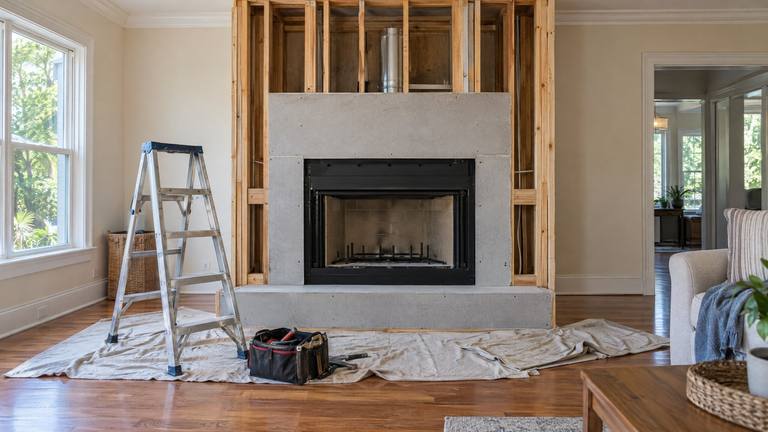
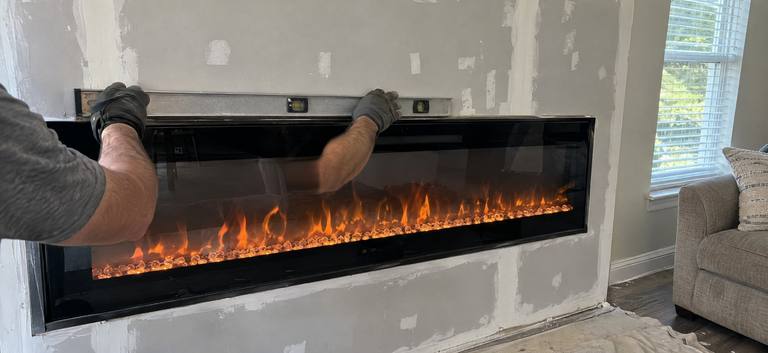
The second path swaps the open firebox for a sealed one: a direct-vent insert with a glass front, sized to the opening. It is a heater, listed to ANSI Z21.88, and it breathes outdoor air and exhausts to the outdoors through its own pipes. In an existing chimney those pipes are two flexible liners run side by side to a termination at the top, one for intake and one for exhaust, or a co-axial pipe where the flue is straight enough.
The insert closes the fireplace off. A surround covers the gap around it, the damper is removed or fixed open to let the liners through, and the room air no longer goes up the chimney. Inserts can carry thermostats, remotes and fans, and newer inserts ship with a mesh barrier over the hot glass, a requirement the standard added in 2015.
Gas logs vs gas insert, point by point
Set side by side, the two paths differ on almost every count that matters day to day.
- Look: a log set keeps the open fireplace and a larger flame; an insert puts the fire behind glass inside a metal surround.
- Heat: a vented log set is decorative; a vent-free set and a sealed insert are heaters, and the insert keeps its exhaust out of the room.
- Damper and chimney: a vented set needs the damper fixed open and a working chimney; an insert runs its own liners and closes the chimney off.
- Room air: a vented set and an open fireplace draw room air up the chimney; a sealed insert does not.
- Scope: a log set needs a gas line and the right burner size; an insert also needs a liner kit, a termination at the top and a surround.
What the chimney has to pass first
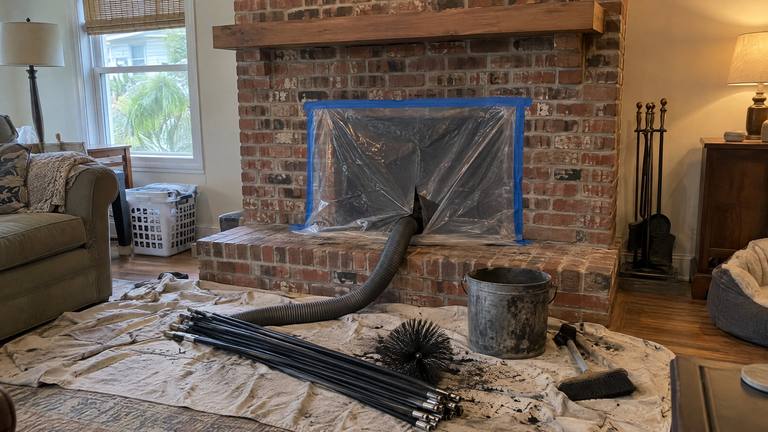
A chimney that served wood fires carries soot and deposits, and gas appliances are not installed into that. Section 503.5.6 of the Fuel Gas volume requires a chimney passageway to be examined before an appliance is connected and cleaned if it previously vented solid fuel. Log set manuals agree. One lists soot, creosote, ashes and loose paint as what has to come out of the flue, the damper and the firebox, calls for an inspection before installation, and cautions that an older fireplace may need repairs before it can take a set.
Beyond cleaning, the fireplace has to be sound. For a log set, that means a firebox without open joints or loose brick, a damper that can be clamped open, a firebox floor level enough for the burner, and a chimney that is open to the top and capped. For an insert, it also means a throat and smoke shelf the liners can pass through and a chimney top solid enough to carry the termination. Any repair goes on the estimate ahead of the gas work.
Getting gas to the fireplace
Each appliance is built for one gas, natural gas or propane, as its rating plate shows, and some cannot be switched in the field. Its manual gives the lowest and highest inlet pressure it will accept and the smallest supply pipe it can use, and the gas line is sized so the appliance gets that pressure at full flow. One log set manual warns against connecting directly to an unregulated propane tank or to a portable propane cylinder.
Running the line, fitting the shutoff valve and testing the joints for leaks is gas piping work, covered by NFPA 54. It is separate from setting the logs or the insert, and the written estimate should say who does it. Whether the job needs a permit is the building department's decision. If the appliance has electronic ignition, a remote receiver or a fan, it may also need an outlet near the fireplace, which is electrical work.
Ignition and controls
Section 602.2 of the Fuel Gas volume requires a log set for a solid-fuel fireplace to light its main burner from a direct ignition device, an igniter or a pilot flame, and to carry a flame safeguard that shuts the gas off if ignition fails. The exception is a manually lighted natural gas set listed to ANSI Z21.84.
Beyond that, the choice is yours: a standing pilot with a wall switch, electronic ignition with a remote, or a thermostat on a heater-rated unit. One dual-listed log set's manual prohibits its thermostat function when the set runs vented. Settle the controls before the gas line goes in, so the valve, the switch wiring and any receiver land where the manual shows them.
Living with it afterward
Once a gas appliance is in the fireplace, wood fires stop; log set manuals forbid burning wood or any other solid fuel alongside the set. The damper clamp on a vented set stays in place for as long as the set does. They also ask for a service technician to look the appliance over before its first use and every year after.
Section 553.885 of the Florida Statutes covers buildings constructed on or after July 1, 2008 with a fireplace or a fuel-burning appliance, and it puts an alarm within 10 feet of every bedroom. A house built earlier falls outside that date, but the alarm earns its place there just the same.
FAQ
Frequently asked questions
Which conversion gives more heat, logs or an insert?
A sealed direct-vent insert, because it is built and listed as a heater and keeps the room air out of its combustion. A vent-free log set also heats the room, within its room-size limits. A vented log set is decorative, and its heat leaves with the exhaust.
Can a factory-built wood fireplace be converted to gas?
Only with appliances the fireplace maker's listing allows. The code bars unvented log heaters in a factory-built fireplace unless it was tested and listed for them, and a fireplace maker may not permit an insert at all. The fireplace manual is the starting point.
My house has no natural gas. Can I still convert?
Yes, with an appliance built for propane and a regulated propane supply sized to the manual's pressure requirements. The appliance's rating plate has to match the gas it is connected to.
Can I still burn wood after converting?
No. The log set manuals we follow rule out wood or any other solid fuel once a set is in, and an insert closes the firebox off. Going back to wood means removing the gas appliance and having the chimney checked first.
Does the chimney need a new liner for gas logs?
A vented log set uses the chimney as a fireplace flue, with the damper fixed open, so the chimney has to be sound, clean and open to the top. A direct-vent insert is different: it brings its own listed liners, run inside the flue to a termination at the top.

Proudly American
A family business that answers its own phone.
Guides
Chimney and fireplace guides
-
-
-


Book your free inspection
One call gets you a time slot and a free inspection. No pressure to decide on the day.
Free Inspection