
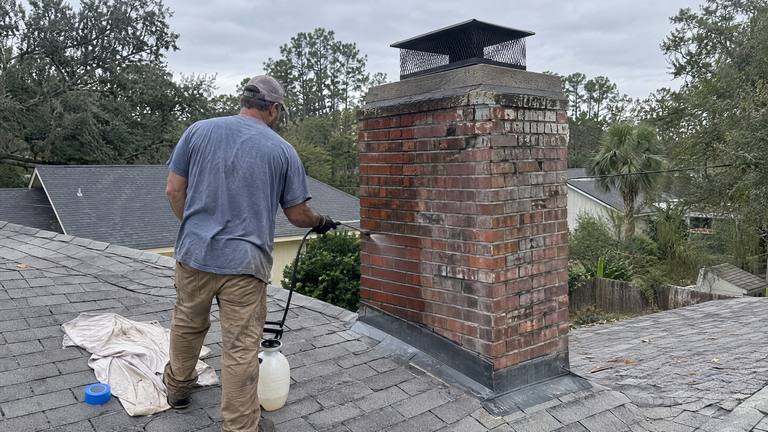
Local chimney waterproofing in Lake Geneva
Breathable silane or siloxane repellents for Lake Geneva chimneys, applied the way the data sheet says once a free inspection clears the brick.
- Fully licensed and insured
- Locally owned
- Family owned and operated
- Same-day service
Get Your Free Inspection
Get a quote for chimney and fireplace repair and installation in Jacksonville.
Request received
Thank you. We will call you shortly to set a time.
Quicker by phone? Call (904) 920-5495
Chimney waterproofing specialists who test before spraying
- Locally owned in Jacksonville
- Family owned and operated
- 100% satisfaction guaranteed
- Free inspection and estimate
- Same-day service available
- 10% off any service
A splash test shows which faces drink water, and those are the faces we treat.
- Free inspection and estimateWe splash test your Lake Geneva chimney at no charge and tell you if the brick needs treatment at all.
- No hidden feesRepairs and repellent are separate lines, and nothing is added once the spraying starts.
- 100% satisfaction guaranteedIf treated brick still soaks up water where we sprayed, we come back and put it right.
Green staining on one face
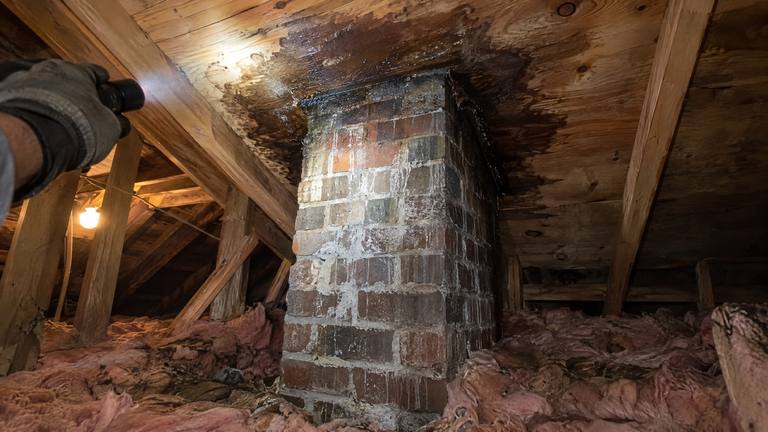
Green or dark staining on one side of a chimney means that face stays damp long enough for growth to take hold, and the brick there dries more slowly than the rest. Where a chimney in Lake Geneva shows it, we check whether that face also has open joints or a leaking crown above it, since either would keep it wet. The staining is cleaned off gently, without harsh acid, and any repairs are made. After that, a breathable repellent can help the face dry out sooner after each rain. The cleaning, the repairs and the treatment are priced as three separate lines. Call (904) 920-5495 and our waterproofing pros will test your Lake Geneva brick for free.
Lake Geneva falls within Clay County. Lake Geneva lies inland.
Test, repair, then treat
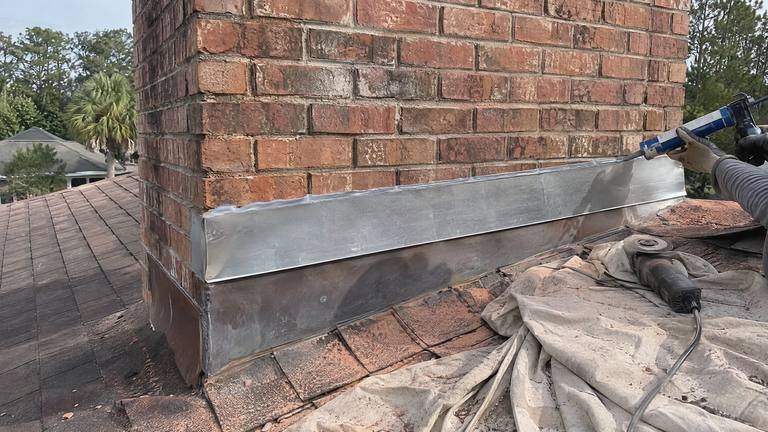
- Crown, cap and flashing checked for openings first
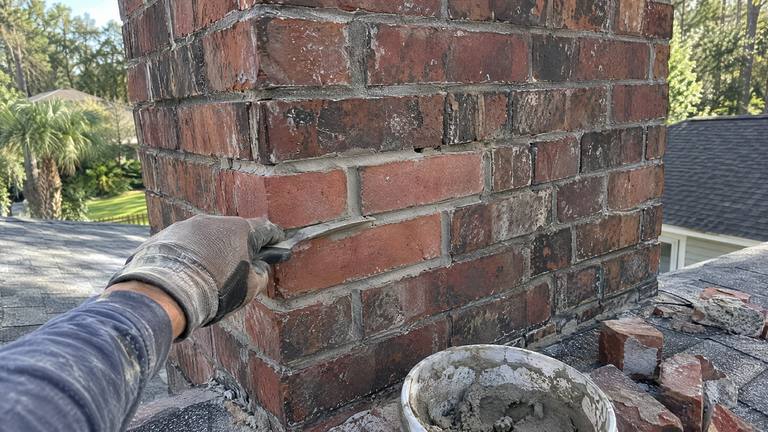
- Open joints and cracked brick repaired before treatment
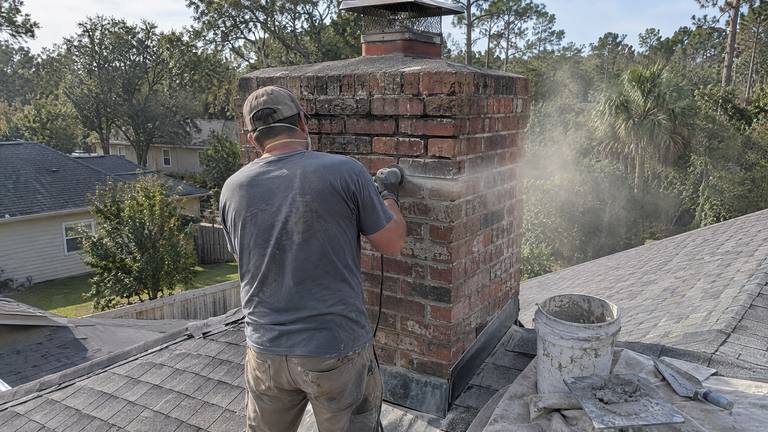
- Brick cleaned so the repellent reaches the pores
- Splash test shown to you when the Lake Geneva job is done
How our waterproofing specialists treat a chimney in Lake Geneva
-
Splash test every face
Water on each face shows where the brick soaks it up, and the crown, cap and flashing are checked for openings.
-
Openings closed and cured
Joints, brick, crown and flashing are repaired first, and the cure time on the data sheet runs its course.
-
Clean, patch test, then flood
The brick is cleaned, a test patch dries beside untreated brick, then the repellent goes on from the bottom up.
-
Dry and retest
Once it has cured, we splash the faces again so you can see the water bead off.
Painted chimneys in Lake Geneva
The repellent we use is not made for painted or glazed brick, since paint already forms a film on the face. Spraying over it does nothing useful.
For a painted chimney in Lake Geneva, we talk through the options for the paint before any treatment is priced.
10% off any service booked within 72 hours of inspection
Treating your Lake Geneva chimney? Three days is enough to decide and still save 10%.
Temperature limits on the data sheet
Clear repellents cure through a chemical reaction, and heat and cold both change how that reaction goes. The product's directions set the window at 40 to 100 degrees Fahrenheit for both the surface and the air, holding for three hours after application, and BIA gives a similar typical range for brick coatings. A chimney face in full sun can run well above the air temperature, so on a hot day the work may be timed for the morning or started on the shaded faces first. The same timing keeps the product from flashing off before it has soaked in properly.
The test patch before the whole chimney
Brick varies from wall to wall, and a treatment that looks invisible on one chimney may darken another slightly. A trial area shows how much product the brick drinks, how it looks once dry, and whether water beads on it after cure. BIA recommends trial areas of at least 10 square feet in a spot that represents the surface to be treated, cured as the product maker directs before judging. On a chimney, that means one section of one face done first, sprayed with water once it has cured, and compared side by side with untreated brick next to it before any decision on the rest.
More is not better
A heavier coat of repellent can seem like better value. BIA's note says the coverage rate is critical, because putting on too much can cut the breathability of the masonry, and breathability is the whole reason for choosing a penetrant over a film. The maker of the product we use gives a coverage range per gallon that depends on how porous the surface is, and very dense brick takes less than soft brick. We work within that range, keep track of how much each face has taken, and record it in the job notes so the next treatment can be planned from real figures.
Tested before any repellent goes on in Lake Geneva
- Splash test of each face to show where the brick absorbs water
- Surface cleaning method, and any old coating that must come off
- Weather window: dry masonry, no rain forecast, temperature in range
- Application method and coverage rate from the maker's sheet
Before any sealer goes on
Will waterproofing stop water coming into my fireplace?
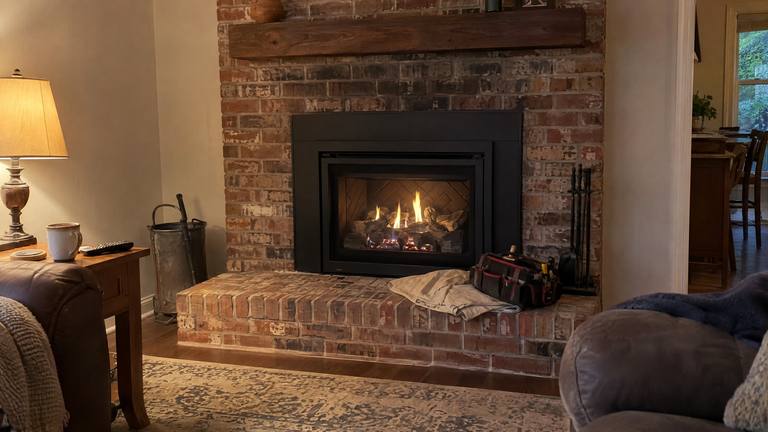
Not if the water comes down the flue or through the crown. Those paths are closed with a cap or crown repair, and treatment of the brick faces comes afterward if it is still needed.
What if my chimney does not need treatment?
Then we tell you. If the brick sheds water and the joints, crown and flashing are sound, treatment is left off the estimate.
More services in Lake Geneva
-
-
-
-
-
-


Learn more about chimney waterproofingAll services in Lake Geneva
Brick that sheds rain in Lake Geneva
Dark, damp brick in Lake Geneva? A splash test at no charge tells us whether it drinks water.
Free Inspection