
Family-owned vent-free fireplace service in Ortega
Yearly ventless service in Ortega: pilot, burner, logs and room checked, backed by our 100% satisfaction guarantee.
- Fully licensed and insured
- Locally owned
- Family owned and operated
- Same-day service
Get Your Free Inspection
Get a quote for chimney and fireplace repair and installation in Jacksonville.
Request received
Thank you. We will call you shortly to set a time.
Quicker by phone? Call (904) 920-5495
Ventless fireplace specialists for Ortega homes
- Locally owned in Jacksonville
- Family owned and operated
- 100% satisfaction guaranteed
- Free inspection and estimate
- Same-day service available
- 10% off any service
Supply piping problems are named for the gas utility or a contractor.
- Free inspection and estimateThe rating plate, the room and the flame of your unit in Ortega are checked on a free visit.
- Upfront pricing, no hidden feesCleaning, listed parts and labor are priced in writing before anything is ordered or fitted.
- 100% satisfaction guaranteedIf the unit does not run the way we said after our service, we come back and put it right.
Pets, lint and the sensor pilot
Pet hair and household lint drift toward a running vent-free unit and settle on the pilot's air opening, in the burner ports and at the air inlet. At the sensor pilot, a small amount is enough to trip the shutoff. Homes with more than one pet can need the pilot cleaned more often.
In homes in Ortega with pets, we clean the pilot and burner as the manual allows and suggest a cleaning interval shorter than a year where the lint builds up quickly.
Ortega is a neighborhood within the City of Jacksonville. Ortega sits in Duval County.
What our crew checks and fixes on ventless units in Ortega
- Logs reset to the maker's diagram
- Gas pressure measured against the rating plate
- Every opened joint leak checked
- Soot problems traced to their cause
Plate, room, pilot, logs
-
Rating plate and gas confirmed
The model, gas, listing and input are read and the gas confirmed at the valve before parts are ordered.
-
Room measured against the code
The room volume and every unvented input in it are compared with the code and the manual.
-
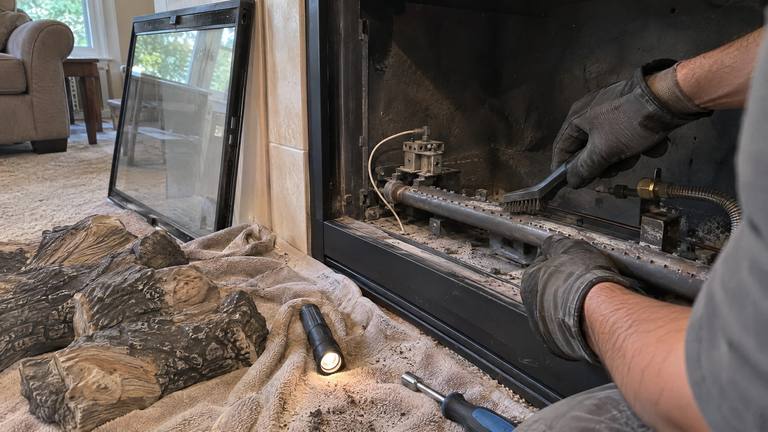
Pilot, burner and logs serviced
The sensor pilot and burner are cleaned, the logs set to the diagram and worn parts replaced.
-
Leak checked and run through a cycle
Opened joints are leak checked, the flame is watched through a full cycle and findings are written down.
Water vapor from a unit in Ortega
Water vapor goes into the room wherever the unit is, about an ounce per 1,000 Btu per hour by one manual's figure. In Ortega, fogged windows while it runs are a sign to check the room size.
The room is measured, and the ticket says whether the unit suits it.
10% off any service booked within 72 hours of inspection
A vent-free unit in Ortega is serviced to its manual, and the visit comes 10% off.
How the oxygen depletion sensor works
On a vent-free set, the oxygen depletion sensor is built into the pilot. The pilot flame is shaped to play on a thermocouple. As oxygen in the room drops, the flame lifts off, the thermocouple cools, and the valve shuts off the gas to the pilot and burner.
The same thing happens when lint or dust starves the pilot of air, which is why a dirty sensor can trip in a room with plenty of oxygen. Cleaning the pilot comes first, done as the manual describes. The design means the sensor responds to the air right at the pilot, which is why lint and drafts at that spot matter so much.
Matching parts to the gas on the plate
Pilots, burners and valves are made for natural gas or for propane, and the wrong one burns wrong. The gas a unit was built to burn is printed on its rating plate, and a conversion is allowed only with the maker's kit where the manual permits it.
We check which gas actually reaches the valve before ordering any gas-carrying part, so what arrives matches your supply. A conversion, where it is allowed, is priced as its own line with the kit named. A unit that was converted in the past is checked to confirm the conversion matches the gas now supplied.
Vent-free sets and factory-built fireplaces
Section 621.7 of the fuel gas code and R1004.4 of the residential code bar unvented log heaters from factory-built fireplaces that lack a listing for them. The fireplace's label says whether it has one.
We read that label before servicing a set in a metal firebox. Where the combination is not listed, we write down what we found and explain the options rather than putting the set back into use. Moving the set to a masonry fireplace where it is allowed, or replacing the fireplace, are the alternatives we set out.
Plate, room, pilot and logs, in writing
- Room measured and unvented input compared with the code limit
- Sensor pilot cleaned by the manual's method, flame shape checked
- Burner ports and air inlet cleaned with the gas off
- Soot sources traced before any wall cleaning is priced
Vent-free fireplace questions from Ortega
Could you set the sensor so it stops tripping?
No. The code forbids field adjustment of the oxygen depletion shutoff, and we never bypass it. A dirty pilot is cleaned, and a worn one is replaced with the listed assembly.
Is my room big enough for the unit?
The room is measured, every unvented appliance in it is added up, and we compare the total with the code's limit of 20 Btu per hour per cubic foot. The arithmetic is written on your ticket.
More services in Ortega
-
-
-
-
-
-


Learn more about ventless gas fireplace serviceAll services in Ortega
Sensor, burner, logs and room
Read us the model on the rating plate when you call (904) 920-5495, and the right pilot parts come to the free visit in Ortega.
Free Inspection