
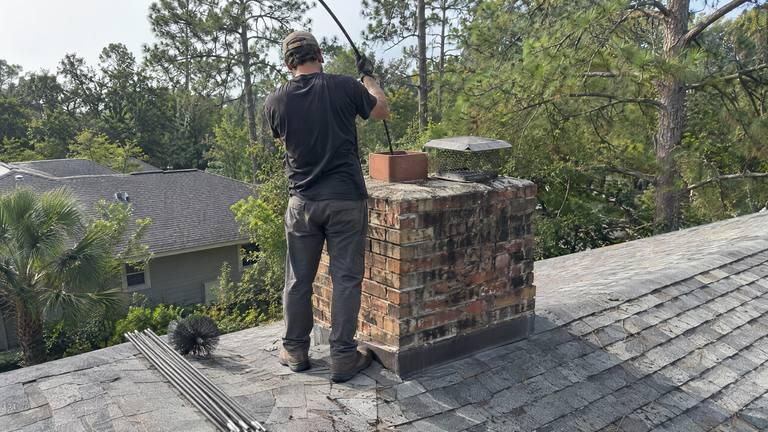
Glazed creosote removal in Ortega
Stubborn deposits in Ortega chimneys cleared with care for the liner, under our workmanship warranty.
- Fully licensed and insured
- Locally owned
- Family owned and operated
- Same-day service
Get Your Free Inspection
Get a quote for chimney and fireplace repair and installation in Jacksonville.
Request received
Thank you. We will call you shortly to set a time.
Quicker by phone? Call (904) 920-5495
Local creosote pros for Ortega chimneys
- Locally owned in Jacksonville
- Family owned and operated
- 100% satisfaction guaranteed
- Free inspection and estimate
- Same-day service available
- 10% off any service
Relining is offered only when cleaning would not be the better spend.
- Free inspection and estimateThe glaze in your Ortega flue is mapped by height and the liner checked at no charge.
- 100% satisfaction guaranteedIf the flue is not left bare, examined and clean as agreed, we come back and finish it.
- Family owned and operatedA family business chooses the method and does the work, so the care taken with your liner stays in one set of hands.
Deciding between removal and relining
Some glazed flues are better relined than cleaned. When the glaze is thick and the tile under it is already cracked, or when the flue is so oversized that deposits will return fast, removal alone may not be the best spend. Neither choice is pushed; the numbers and the flue's condition make the case.
We lay out both options with their reasons. Removal restores a sound flue. Relining replaces a flue that cannot be made sound or right-sized. You choose, with both prices in hand. Unsure which your Ortega flue needs? Phone (904) 920-5495; our creosote specialists inspect it for free.
Ortega falls within Duval County. Ortega is an inland community.
What creosote removal covers in Ortega
- Method matched to clay tile or stainless liner
- Firebox sealed under a filtered vacuum
- Treatment rounds scheduled with written rules
- Bare flue examined from both ends
How creosote removal runs
-
Glaze mapped, liner checked
The deposits are recorded by height and the liner assessed before a method is chosen.
-
Room sealed and protected
The fireplace opening is closed with a panel under a filtered vacuum, and the hearth area covered.
-
Rotary passes or treatment rounds
Glaze is broken loose with rotary tools on sound tile, or softened with a labeled treatment and brushed away.
-
Bare flue examined
The cleaned flue is checked from both ends, draft tested and burning habits reviewed.
Inserts and creosote in Ortega
Wood inserts run on low air build deposits in their liners and in any flue above them.
In Ortega we check how the insert vents before quoting removal.
10% off any service booked within 72 hours of inspection
Glaze in the flue? The removal you book in the next three days comes 10% off.
Treatments applied over a series of fires
Other treatments work with fires. They are sprayed onto the glaze or added to the fire according to the label, and heat from normal burning helps convert the glaze into a softer, flaky deposit that a brush can remove at the next visit.
These take time, and the label decides how the fireplace is used in between. We hand over those instructions in writing and book the follow-up sweep. The advantage is gentleness on the liner. The trade-off is patience, which is why they suit some flues and not others. We check the flue at the follow-up and brush out what has changed before deciding whether another round is needed.
Cold flues and faster deposits
A flue running up an outside wall, or one that rises well above the roof, loses heat to the air around it. Smoke cools sooner in such a flue, so a larger share of it settles on the tile as creosote.
Nothing is wrong with such a chimney, but it needs more attention. Hotter fires, dry wood and a well-sized flue help. In some cases, an insulated liner keeps the smoke warmer through the chimney, and we price that separately when the glaze keeps coming back despite good burning habits. We point out which parts of the chimney run coldest so you know where deposits will gather first.
Using the fireplace between rounds
When removal takes more than one round, the product label decides whether and how the fireplace may be used in between. Some treatments need fires to work. Others need the fireplace left cold until they are brushed out.
We give you the instructions for your treatment in writing, with the date of the next visit. If the fireplace should not be used, we say so plainly. If it may be used, we explain how, including what kind of fire and for how long, so the treatment works as its maker intends. If you are unsure about a fire, a phone call before lighting it settles the question.
What we record about the glaze in Ortega
- Liner type and visible condition checked before any method is chosen
- Flue size compared with the fire it serves
- Debris bagged, firebox and hearth cleaned before we leave
- Relining priced as an option when glaze keeps returning
Before the glaze comes off
How do I stop the glaze from coming back?
Use wood dried six months or more, let the fire breathe, and skip the long, low, smoky burns. If the flue is oversized or runs cold, a correctly sized liner may be the lasting answer.
What does a creosote inspection in Ortega cost?
The inspection is free, and the method, rounds and price are written down before any work. Book the removal within 72 hours of it and 10% comes off.
More services in Ortega
-
-
-
-
-
-


Get the glaze out of your Ortega flue
Creosote at your Ortega home comes out with the room sealed off, by our family crew, after a free first look.
Free Inspection