
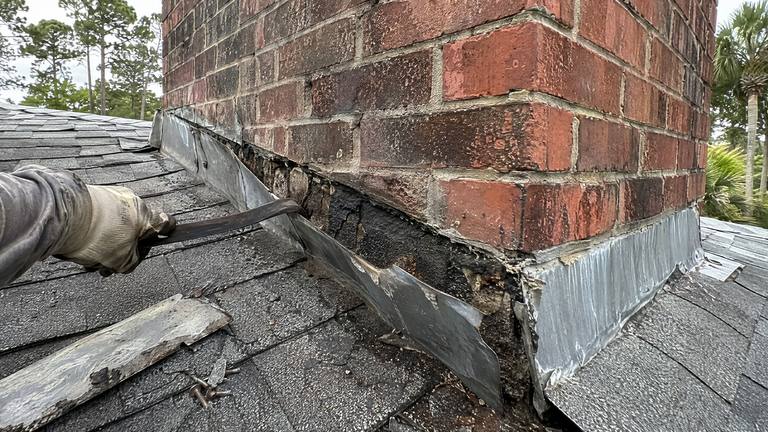
Chimney flashing repair in Nassauville by local flashing experts
Water coming in behind your Nassauville chimney? A free inspection checks the back flashing and answers the cricket question.
- Fully licensed and insured
- Locally owned
- Family owned and operated
- Same-day service
Get Your Free Inspection
Get a quote for chimney and fireplace repair and installation in Jacksonville.
Request received
Thank you. We will call you shortly to set a time.
Quicker by phone? Call (904) 920-5495
Roof line specialists for flashing leaks in Nassauville
- Locally owned in Jacksonville
- Family owned and operated
- 100% satisfaction guaranteed
- Free inspection and estimate
- Same-day service available
- 10% off any service
A caulk bead over failed flashing buys a few months, so in Nassauville we take the joint apart and rebuild it.
- Free inspection and estimateThe flashing check in Nassauville costs nothing, and it includes a look from the attic side.
- No hidden feesAny roofing we lift and reset is priced on the estimate, so the bill does not grow on the roof.
- Workmanship warrantyThe metal we fit and the joints we cut into the brick are covered by our workmanship warranty.
How the flashing estimate is laid out
The flashing estimate lists each side of the chimney separately: the apron, the two sides and the back pan, with what failed on each and what we propose. It names the counter flashing method, the flashing metal, and any mortar joints that are repointed first.
It also lists roofing that must be lifted and who resets it, whether the chimney needs a cricket and who would build it, and anything we noticed that belongs to a roofer. If you are comparing proposals for your Nassauville house, those lines make the jobs easy to set side by side. Each line carries its own price, so nothing is bundled. Our flashing pros check Nassauville roof lines for free; the number is (904) 920-5495.
Nassauville is part of Nassau County. Nassauville sits a short way inland.
Flashing work around the whole stack
- Corner tabs folded so no seam is left open
- Base pieces fastened to the roof deck, clear of the brick
- Tile or metal roof details built to the roof maker's method
- Attic checked after the first heavy rain in Nassauville
How our flashing pros reflash a chimney in Nassauville
-
Attic and roof line read
Stains on the rafters and the state of each flashing side tell us which pieces failed before anything comes apart.
-
Old joint taken apart
Tar and loose metal come off, the roofing beside the chimney is lifted, and open mortar joints are repointed.
-
Base, then counter flashing
Steps, apron and back pan go in under the roofing, then the counter flashing is set into a sawn reglet and sealed.
-
Roofing reset and rain check
The roofing goes back over the new metal, and after the next heavy rain we check the attic side.
Storm-driven rain on Nassauville roof lines
Near the coast, hurricane season storms from June 1 to November 30 push rain across a roof with real force. The uphill face of a chimney in Nassauville catches that water and the debris it carries.
We check the back pan first, clear any debris dam behind the chimney, and flag a cricket on the estimate if the chimney is wide.
10% off any service booked within 72 hours of inspection
Leak beside the chimney? Book the reflashing in the 72 hours after we inspect and 10% comes off.
Copper flashing and the staining below it
Copper is a durable flashing metal for chimneys. It handles the temperatures, it can be set into fresh mortar, and it solders into clean corners. The Brick Industry Association lists one drawback: runoff from copper can stain the crown or the brick below it.
That stain is a greenish or dark streak, and on light brick or stucco it can be visible from the ground. Where staining would be a problem, stainless steel is the alternative. If you choose copper, that possibility is mentioned up front, so staining does not come as a surprise a year later. Copper also darkens as it weathers, which some owners like and some do not.
Minimum flashing thickness under the code
Thickness is part of the flashing choice as much as the metal is. The Florida Building Code, Residential, Table R903.2.1, lists minimum thicknesses for corrosion-resistant flashing by metal. Metal thinner than that dents, tears at bends and corrodes through sooner.
Thin metal turns up on quick repairs because it is easy to bend by hand. We check the thickness of what is there and name the thickness of what we will install, which meets the table and is chosen for the detail. That figure is worth checking when you look at other proposals. Heavier metal also holds a crisp bend at hems and tabs, which keeps laps tight.
Flashing metal on chimneys near salt water
Close to the coast, salt settles on flashing and holds moisture against it, and metals that last well inland corrode faster. Galvanized steel loses its zinc coating sooner, and fasteners that do not match the flashing metal corrode at the contact point.
For chimneys in this band we choose stainless steel or copper for flashing and fasteners of a compatible metal, following the Brick Industry Association's guidance and each maker's exposure notes. We also look harder at existing flashing along the roof line, because salt-driven corrosion can hide under the lap where the metal stays wet longest. Fasteners there are checked one by one.
Checked at the roof line in Nassauville
- Failed pieces identified by side: apron, steps, back pan or corners
- Removal of old tar, cement and caulk so the joint can be judged
- Sealant type and joint preparation where the detail calls for sealant
- Laps and corner tabs formed so water runs downhill
Before your chimney is reflashed
Is copper or stainless steel better for chimney flashing?
Both are durable around masonry. Copper solders neatly but can stain light brick below it; stainless steel does not stain but is stiffer to form. The choice also depends on your roof's metal, and the estimate explains which we recommend.
Could only one side of the flashing be replaced?
Yes, when the other sides are sound. A counter flashing that has pulled loose on one side can be reset, or one run of steps replaced. The estimate says what stays and why.
More services in Nassauville
-
-
-
-
-
-


Learn more about chimney flashing repairAll services in Nassauville
Flashing set into the brick in Nassauville
A local roof line specialist finds the failed pieces on your Nassauville chimney and writes the price down.
Free Inspection