Factory-built or masonry: reading your fireplace from the firebox up
Five places to look, and why the answer changes every repair.
- Family owned and operated
- Free inspection and estimate
- Same-day service available
- Upfront pricing, no hidden fees
Get Your Free Inspection
Get a quote for chimney and fireplace repair and installation in Jacksonville.
Request received
Thank you. We will call you shortly to set a time.
or call (904) 920-5495
In short
Telling a prefab vs masonry chimney apart takes a few visible tells. A factory-built fireplace has a metal body or molded refractory panels, a round metal flue, a rating label from its maker, and a metal cap or chase top. A masonry fireplace has firebrick laid in mortar, a masonry smoke chamber and a clay or masonry flue. The answer decides how every repair is done.
Two systems built under two sets of rules
Prefab vs masonry fireplace is really a question of which rulebook applies. A masonry fireplace and chimney are built on site from brick, block, stone, concrete and clay flue lining, to the rules in the Florida Building Code, Residential, sections R1001 (masonry fireplaces) and R1003 (masonry chimneys). The code sets the thickness of the firebox walls, the size of the hearth, the smoke chamber shape and the flue lining.
The factory-built kind leaves the factory as one tested product. Section R1004 requires it to carry a listing and a label, to have passed UL 127 testing, and to be installed as the listing directs. Its chimney is part of the same system: R1005.4 says chimneys for factory-built fireplaces comply with UL 127, while factory-built chimneys serving other solid-fuel appliances are tested to UL 103. Everything about a factory-built unit, from its clearances to its replacement parts, comes from the maker's listing, not from masonry rules.
How to tell if a fireplace is prefab: start with the firebox walls
Look closely at the back and side walls. Firebrick in a masonry firebox is individual bricks laid in mortar, with real joints you can feel with a fingernail and bricks that differ slightly in size and color. A factory-built unit's molded refractory comes as large slabs, sometimes stamped with a brick pattern, with fake joints that are part of the casting and straight seams where the panels meet at the corners.
Metal grilles or louvers above and below the opening are another sign. Those belong to circulating factory-built units, which pull room air in at the bottom and push warmed air out at the top. Be aware that section R1001.5.1 allows a masonry fireplace to be built around a steel firebox unit, so a metal firebox alone does not settle the question.
The rating label
The rating label is the clearest evidence. A factory-built fireplace carries a metal plate or sticker from its maker giving the model, the listing and the clearances it needs to combustible framing. Look inside the opening on the side walls, on the smoke dome above, or behind a lower grille if the unit has one. A masonry fireplace has no such label.
If you find a label, write down the maker and model and keep them with your house papers. That number is how the manual, the listed parts and the clearances are found later.
What you see above the damper
When the firebox is cool, open the damper and look up with a flashlight. In a masonry fireplace you see a smoke chamber of brick or smooth parging sloping in toward a rectangular or square flue opening lined with clay tile or another masonry lining. In a factory-built unit you see a smooth metal dome narrowing to a round metal pipe, and the damper sits at the base of that pipe.
A round metal flue is a strong sign of a factory-built system. A rectangular clay flue is a strong sign of masonry. A round stainless liner inside a rectangular opening means a masonry chimney that has been relined.
The attic, the chase and the roof
If the chimney passes through an attic, look at it there. A factory-built chimney is a round metal pipe with one or more outer casings, held by metal firestop spacers where it passes through the ceiling and the roof framing. A masonry chimney in the attic is solid brick or block.
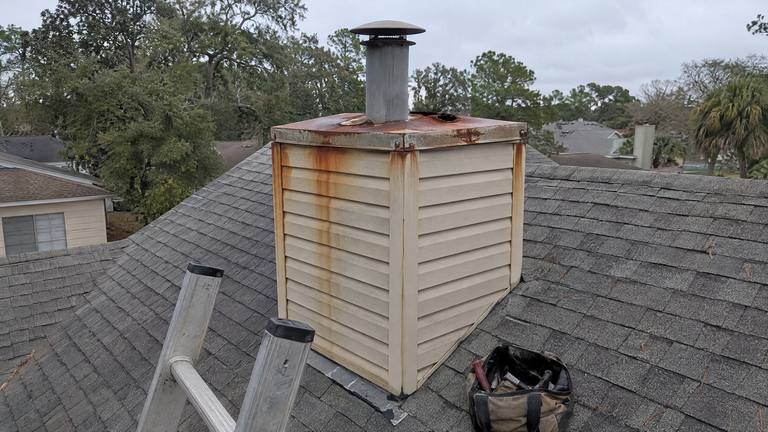
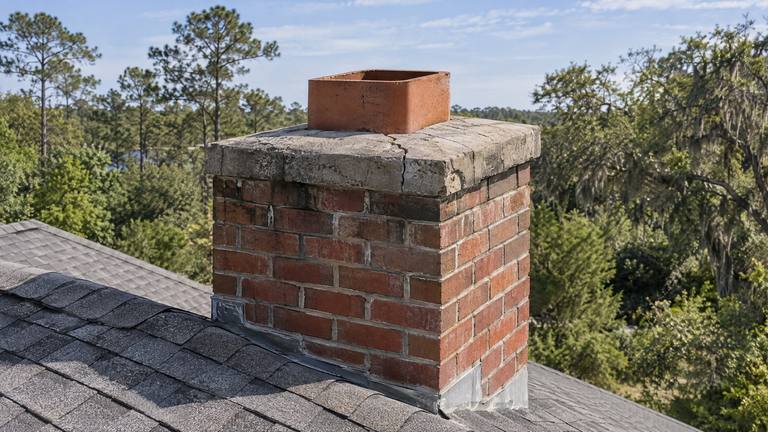
Outside, a factory-built chimney may be boxed in a framed chase finished with siding or stucco, capped by a sheet-metal chase cover that the round flue and its termination poke through. A masonry chimney ends in a concrete crown with clay flue tiles or a cap on top. The outside alone can mislead, though. Brick veneer can wrap a metal chimney, and stucco can cover either type. Tapping helps: a framed chase sounds hollow, solid masonry does not.
The hearth, the face and what holds them up
A masonry fireplace is heavy and sits on its own foundation. Its hearth is concrete or masonry at least 4 inches thick under section R1001.9.1, and the extension in front is at least 2 inches of concrete or masonry on noncombustible support. Knock on it and it sounds solid all the way across.
A factory-built unit sits on the framed floor like a cabinet. Its hearth extension follows the listing under section R1004.2 and can be a thin listed board, tile or stone laid on the floor, marked off so it is readily distinguishable from the floor around it. The face around the opening may be tile or stone set on a backer board over framing. Alone, this tell is weak, because both types can be finished to look alike, but it adds weight when the label and the flue point the same way.
Zero-clearance vs masonry fireplace: what the name means
Factory-built fireplaces are also sold as zero-clearance units. The name means the unit was tested to sit close to, or in places against, wood framing, because its casing and air spaces keep the outside of the unit cool enough. That permission comes from the listing, and it holds only while every part of the listed system stays in place. A masonry fireplace, by contrast, needs a 2-inch gap between its front faces and sides and any framing, and 4 inches at the back, under section R1001.11, unless one of that section's exceptions applies.
Why the answer changes every repair
A masonry fireplace is repaired with masonry: firebrick in refractory mortar, rebuilt smoke chambers, new crowns, relining with listed liners where an appliance needs one. A factory-built fireplace is repaired only with its maker's listed parts, such as panels, grates, doors and chimney sections from the same system, because any substitute takes it outside its listing.
The code also rules certain additions out for factory-built units unless the unit's listing covers them: gasketed doors (R1004.5), unvented gas log heaters (R1004.4) and decorative shrouds at the chimney top (R1004.3). When a factory-built firebox or chimney has failed and no listed parts exist, the repair is replacing the fireplace and chimney as a new listed system. Both types still need a yearly inspection under NFPA 211.
FAQ
Frequently asked questions
Is a factory-built fireplace less safe than a masonry one?
Not when each is installed and kept up to the rules that apply to it. The difference is in how they fail and how they are repaired. A factory-built unit depends on its listed parts staying intact, and a masonry fireplace depends on its masonry and clearances staying sound.
Can a factory-built chimney be dressed up with brick or a decorative top?
The chase around it can be finished as the listing allows, including brick veneer in some cases. A decorative shroud at the top is not allowed unless it is listed for that specific chimney system, under the residential code.
Is a wood insert an option for a factory-built fireplace?
Only if both the fireplace maker and the insert maker allow it for those models. A maker can rule inserts out for its fireplaces, and at least one does. Where it is allowed, the insert manuals call for a full-length liner.
What should I look for first if my fireplace is factory-built?
The rating label. The maker, the model and the clearances are printed on it, and it is how the manual and the listed parts are found. If the manual is missing, the model number is how you ask the maker for a copy.
Can a masonry fireplace be replaced with a factory-built one?
It can, as a new installation of a complete listed fireplace and chimney system. That is a different job from a repair, and the estimate should cover the existing masonry, the new unit, its chimney and its hearth requirements.

Proudly American
Family owned and operated, from the first call to the final walk-through.
Guides
Chimney and fireplace guides
-
-
-


Call your local chimney team
One call gets you a time slot and a free inspection. No pressure to decide on the day.
Free Inspection