
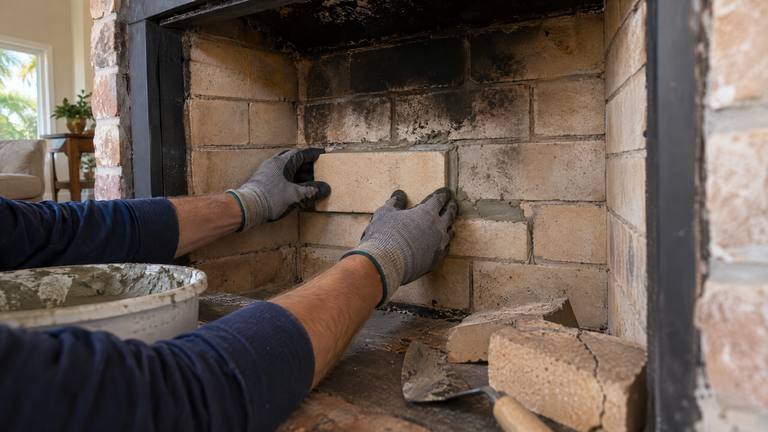
Firebox repair in Brooklyn
The back wall, the side walls and the floor of your Brooklyn firebox, each checked free and quoted separately.
- Fully licensed and insured
- Locally owned
- Family owned and operated
- Same-day service
Get Your Free Inspection
Get a quote for chimney and fireplace repair and installation in Jacksonville.
Request received
Thank you. We will call you shortly to set a time.
Quicker by phone? Call (904) 920-5495
Firebox specialists who test every brick in Brooklyn
- Locally owned in Jacksonville
- Family owned and operated
- 100% satisfaction guaranteed
- Free inspection and estimate
- Same-day service available
- 10% off any service
Each wall of your Brooklyn firebox gets its own line, so a sound wall is not rebuilt along with a failed one.
- Free inspection and estimateEvery wall of the firebox in Brooklyn is tapped and probed cold, and the failed bricks and joints are marked at no charge.
- Upfront pricing, no hidden feesEach wall is quoted for what it needs, a few joints, a few bricks or a full reline, so a small repair stays small.
- 100% satisfaction guaranteedIf a joint we repointed opens again after it has cured and been used as the ticket says, we come back and redo it.
Firebox floor bricks cracked through
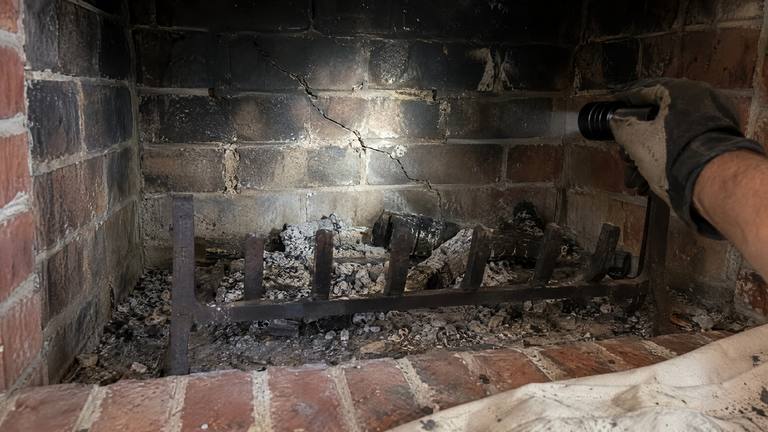
The firebrick floor of the firebox carries the grate, the fire and the ash. A floor brick cracked across, or one sitting lower than its neighbors, shows up as a rocking grate, a gap under the ash or a grate that no longer sits level.
We lift cracked or sunken floor bricks, check the bed beneath them and reset or replace them flat in refractory mortar. The hearth in front of the opening is a separate item on the estimate, with its own rules. Floor bricks cracked in the Brooklyn firebox? Get a free look by calling (904) 920-5495.
Brooklyn is one of the named neighborhoods of Jacksonville. Brooklyn falls within Duval County.
Joints, firebrick, walls and floor
- Cracked firebrick replaced to size, one brick at a time
- Flaking brick faces measured against the code thickness
- Back walls relined when patching will not hold
- Rumford fireboxes relined to their original angles
How firebox repair runs
-
Keep the firebox cold
Let the fireplace go unused for several hours ahead of our visit, so each wall is cool to the touch.
-
Tap, probe and mark
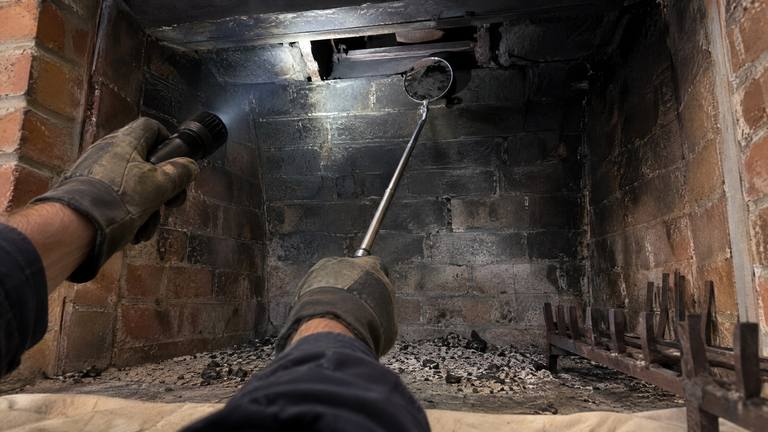
Each brick is sounded, each joint probed, and the failed ones marked and written up by wall.
-
Rake, rebrick or reline
Joints are raked and repointed, failed bricks replaced and worn walls relined in C199 mortar.
-
Cure date on the ticket
The mortar maker's drying time sets the date of the first small fire, written down before we leave.
Firebox joints far from the water
Inland in Brooklyn, the mortar in a firebox fails from heat and age rather than salt. One early sign is sandy grit on the grate or the floor after a fire.
Raking and repointing those joints in medium-duty refractory mortar is often the whole job.
10% off any service booked within 72 hours of inspection
Refractory mortar or new firebrick, either one comes 10% off.
Reading the label on a tub of fireplace cement
Tubs of premixed fireplace cement are sold for firebrick repair, and their labels are worth a close look. One widely sold premixed refractory cement is rated to 2,000 degrees Fahrenheit and lists ASTM E136, a test of whether a material burns, rather than the C199 pier test. It is also made for joints of a quarter inch or less, with a sixteenth of an inch as its minimum.
A product like that has its place, but it is not automatically the medium-duty mortar R1001.5 calls for between firebricks. We compare each product's stated standard with the code before choosing it for a joint.
Full firebrick or thin splits
Firebrick comes in more than one thickness. A full-size brick is commonly 9 by 4 1/2 by 2 1/2 inches, while a split has the same face size at about 1 1/4 inches thick and is made to line stoves and inserts.
Inside a masonry firebox the difference matters. The code credits the lining toward an 8-inch wall only when the lining is at least 2 inches thick, and a split alone falls short of that. When a wall is relined, we choose the brick thickness against that figure and the space available in the firebox, and the estimate states which brick is used and why.
A firebox that got wet
Water that reaches the firebox, down the flue or from a leak above, soaks into firebrick and joints. Masonry heated while wet can crack as the water turns to steam, the same reason refractory mortar makers ask for their product to dry fully before a fire.
When we find water marks or damp brick, the source goes on the estimate as its own item, the firebox is left to dry before any repair or fire, and no new mortar is packed over wet joints. That order keeps the repair from being damaged on its first night. Stopping the water is a separate job with its own price.
Checked in Brooklyn before any brick comes out
- Back wall slope and throat height kept on any rebuild
- Damper frame supported and reset when the back wall is rebuilt
- Hairline cracks left in place and noted for later checks
- Smoke chamber, damper and hearth items kept on their own lines
Before the first fire after a repair
Can you replace just the bad firebricks in Brooklyn?
Yes. Cracked, hollow or worn-through firebricks come out individually and new ones go in, and the sound bricks around them stay. A full reline is written up only when a whole wall has worn.
Is the inspection really free?
Yes. The firebox check and the written estimate cost nothing, and the pricing is upfront with no hidden fees. Book the repair within 72 hours of the check and 10% comes off.
More services in Brooklyn
-
-
-
-
-
-


A sound firebox for your Brooklyn fireplace
A local firebox specialist marks each failed joint and brick in Brooklyn and prices each wall separately.
Free Inspection