
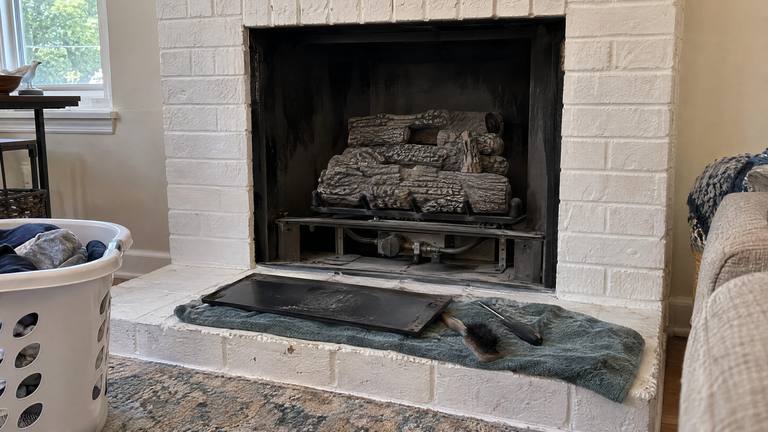
When the gas fireplace does not respond to its remote
Separate the handset, receiver and appliance before assuming you need a new remote.
- Fully licensed and insured
- Locally owned
- Family owned and operated
- Same-day service
Get Your Free Inspection
Get a quote for chimney and fireplace repair and installation in Jacksonville.
Request received
Thank you. We will call you shortly to set a time.
Quicker by phone? Call (904) 920-5495
The short answer
A gas fireplace remote not working may have depleted batteries, an active lock, an incorrect receiver mode or a lost pairing. The fireplace itself may also lack power or have a separate fault. Start with the exact remote and appliance manuals, limit checks to accessible owner controls, and stop troubleshooting if you smell gas.
Identify the handset and the fireplace separately
Write down the remote model as well as the fireplace model. The two labels answer different questions: one identifies the control instructions; the other identifies the appliance it operates. A similar-looking handset sold online may use a different receiver or offer features your fireplace does not support.
Heat & Glo’s owner resources include model-specific pairing and control guides. Use the guide that matches the equipment you actually have. If the label is missing or hard to reach, a photograph of the visible controls may help when you arrange service. Do not remove the glass or dismantle a control compartment just to identify a remote.
Check the handset before changing appliance settings
For the RC300, Hearth & Home Technologies lists batteries, child lock and button operation among the first troubleshooting checks. Follow your handset manual for battery type, orientation and unlocking. A display lighting up is useful information, but it is not a complete test of whether the receiver has received a command.
Change one documented setting at a time and note the result. If you replace batteries and change several control modes together, it becomes harder to explain which action affected the problem. Keep the old settings in your notes, especially if a thermostat or timer was in use. Avoid a generic factory-reset sequence found for a different product.
A gas fireplace receiver has its own mode and power source
A handset and its receiver are separate parts of the control system. The RC300 manual directs owners to verify the module’s REMOTE position and its power supply when commands are not accepted. Other arrangements differ, so use the matching instructions rather than assuming every receiver contains replaceable batteries.
Only check owner-accessible controls with the appliance off and cool, as the manual allows. If the instructions require access you cannot safely reach or identify, leave that check for service. Report whether the issue began after an outage, battery change or maintenance visit. That context is more helpful than repeatedly pressing the handset button while nothing changes.
Pairing belongs to the exact control system
Pairing lets a compatible remote and receiver recognize each other. A successful pairing procedure for one model is not a general instruction for another. The Natural Blaze manual, for example, describes a specific RC300 and module arrangement; its steps should not be transferred to unrelated equipment.
Before attempting the owner-approved procedure, read the full sequence and identify every control it names. If your controls do not match, stop and confirm the equipment. Keep other people clear of the appliance because a valid command can start it. If pairing fails as described in the manual, record any indicator or message and arrange service instead of opening the receiver.
Compare normal controls only when the manual permits
A documented wall switch can help distinguish a remote-response problem from a wider appliance problem. Use it only in the way the owner’s manual describes. Do not bridge switch wires, bypass a safety device or probe a gas control as a substitute for an operating check.
If the fireplace responds to its normal wall control but not the handset, give that observation to the technician. If neither works, say that too. A separate gas fireplace that will not turn on guide covers the broader appliance question. If the pilot specifically fails to remain lit, use the pilot troubleshooting guide; that is a different symptom from a remote that cannot send a command.
Do not assume every shutdown command has the same priority
The RC300 troubleshooting table explains that an external wired switch left on can prevent the handset from shutting the fireplace off. This is a model-specific example of why all installed controls matter. A remote display saying 'off' should not be your only observation when the burner is visibly still running.
Follow the documented normal shutdown procedure. If the appliance will not shut down normally, stop treating the issue as a routine battery problem and get help. If you smell gas, leave without operating switches, then contact the gas utility or 911 from outside. Keep the service request focused on what the appliance is doing, including which controls have been used.
Arrange the repair with a clear symptom history
Before calling, gather the two model numbers, the manual if available and a short account of the checks you completed. Note whether the display responds, whether the receiver gives its usual indication, and whether the normal wall control works. You do not need to prove which part failed before booking.
Our local, family-owned team provides gas fireplace repair with a free inspection and a written estimate. Call (904) 920-5495 to describe the problem. Ask whether the proposed repair covers the remote, receiver or another appliance component and how compatibility was established. That is more useful than ordering a replacement handset on appearance and discovering that the original problem remains.
Sources
- Hearth & Home Technologies RC300 manual: Batteries, child lock, receiver mode, pairing and external wired-switch interaction for RC300.
- Heat & Glo control and owner resources: Model identification and distinct control/pairing resources.
- Natural Blaze installation and owner manual: Example of a model-specific RC300 pairing sequence and gas-safety instructions.
- Heat & Glo manual library: Matching accessory and appliance manuals rather than generic control instructions.
Frequently asked questions
Should I replace batteries in both parts?
Check the manual before assuming both parts use batteries. The handset and receiver may have different power arrangements, and backup battery instructions also vary by model.
Can I buy any universal fireplace remote?
Compatibility needs to be established for the appliance and receiver. Give the supplier or technician the exact model details before ordering a replacement.
Why does the remote display work but the burner stays off?
A working display does not establish receiver power, the selected mode, pairing or the condition of the fireplace. Follow the documented owner checks and report the response at each stage.
Should I keep resetting a receiver that will not pair?
Use only the matching manual’s procedure. If it does not produce the described response, stop and arrange service rather than repeatedly resetting unfamiliar controls.

Chimney and fireplace guides
-
-
-
-


Call your local chimney team
One call gets you a time slot and a free inspection. No pressure to decide on the day.
Free Inspection