
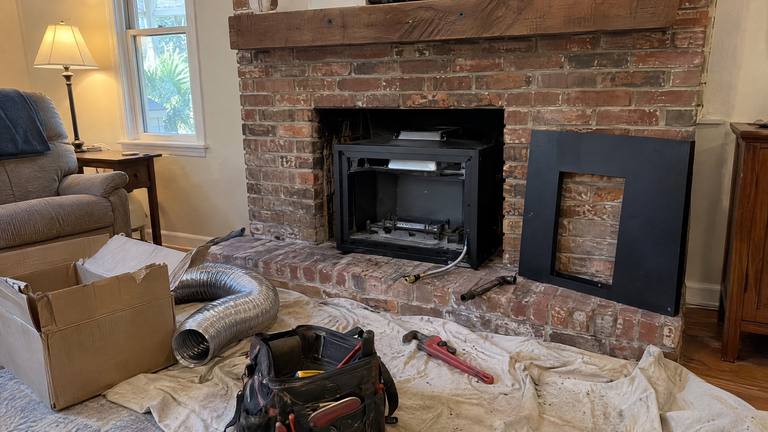
How does a gas fireplace work?
Follow the call for heat from the control to the burner without taking the appliance apart.
- Fully licensed and insured
- Locally owned
- Family owned and operated
- Same-day service
Get Your Free Inspection
Get a quote for chimney and fireplace repair and installation in Jacksonville.
Request received
Thank you. We will call you shortly to set a time.
Quicker by phone? Call (904) 920-5495
The short answer
Gas fireplaces work by admitting the correct fuel through a control valve, igniting it at the burner and managing combustion air and exhaust according to its design. Some models use a standing pilot; others use electronic ignition. Identify the exact model before comparing controls, power-outage operation or venting, because those details are not universal.
Start with the appliance identity
A gas fireplace, a gas insert and a set of gas logs can look similar from across a room. The model label and owner’s manual establish what you have. Heat & Glo provides a guide for locating the rating plate, along with manuals for its different appliances and controls. Read an accessible label with the appliance off and cool; leave removal of unfamiliar panels to the service technician.
Save the model and serial number with the manual. Note whether the fuel label says natural gas or propane. When you call for help, those details are more useful than a description such as 'the fireplace with the black remote.' They let the service conversation start with the correct design and instructions.
The control asks the burner to operate
A wall switch, remote or thermostat can send a request for heat, depending on the model. That request is part of a control sequence, not proof that every component is working. Describe what happens after your normal command: no response, a sound, a small pilot flame, the main burner, or a shutdown.
Separate the command from the observation when reporting a problem. 'The remote display changes but the appliance does nothing' provides a clearer starting point than 'the gas is broken.' Record what you observed during ordinary use, without opening the gas controls or trying to bridge wires. The technician can then follow the appropriate diagnostic sequence for that appliance.
Thermopile vs thermocouple questions start with the model
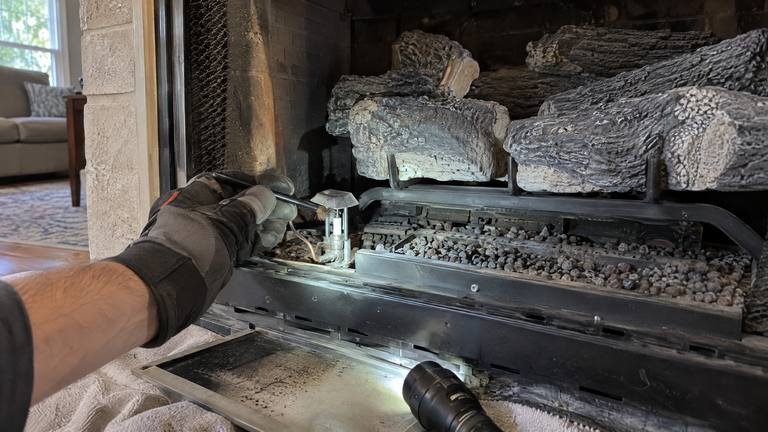
Heat & Glo’s published manuals illustrate both millivolt standing-pilot controls and electronic systems. A standing-pilot arrangement keeps a small pilot flame available to light the burner. The illustrated millivolt system includes a thermopile or thermocouple flame-sensing arrangement. An electronic design uses a powered module and ignition components instead; the exact sequence depends on the model.
That is why a replacement part should not be chosen from the appearance of the fireplace alone. Two units from the same broad product family may have different controls. If a friend’s fireplace has a thermopile, that does not establish that yours uses the same part. Ask the service technician to identify the control system before explaining the repair options.
Combustion air and room air have different jobs
In a direct-vent fireplace, outside air supplies combustion and the exhaust returns outdoors through the vent system. Heat & Glo describes the firebox as separated from the room by its glass assembly. A room-air blower, where fitted, is a separate feature from the path taken by combustion gases.
Do not remove the glass or alter the venting to try to get more heat. The operating instructions for the specific model control which parts must be in place. If you are unsure whether the appliance is direct vent, use the model information to establish that first. Our fireplace venting guide compares the broader categories; the installation should be assessed as a complete system.
Power during an outage is model dependent
A gas supply does not mean every fireplace function will work when electrical power is lost. Heat & Glo explains that some standing-pilot models operate without household power, while some electronic models provide a battery backup for ignition. Follow the manual for battery type, placement and operation; do not transfer a procedure from a different controller.
Before an outage, decide which information you want available on paper: the appliance model, its ordinary shutdown instructions and whether it has a documented backup arrangement. Ask separately about the burner and any fan or other accessories. Treat a backup feature as a model-specific capability, not a promise made by the word 'gas' on a product listing.
Gas fireplace parts have an approved arrangement
Logs, media and glass are part of the manufacturer’s configuration. The Heat & Glo installation guide cited below warns against unapproved parts, altered venting and incorrect positioning of logs or glass. A different-looking log set is not automatically a suitable replacement.
If someone changed the display before you bought the home, tell the technician. Keep any old manual, part receipt or model label you have. Ask whether the current arrangement matches the appliance instructions. Avoid adjusting the logs to copy a photograph online; photographs can show a different model, fuel or media option. The useful question is whether the parts in your particular appliance belong there and are positioned as required.
Know which question belongs to a service visit
Understanding the sequence helps you explain a symptom; it does not replace testing a gas valve, ignition module or vent system. Our gas fireplace repair service begins with a free inspection and a written estimate from our local, family-owned team. Bring the model details and a short description of the last normal operation.
If you smell gas, leave the building without operating switches and contact the gas utility or 911 from outside. For an ordinary control problem with no gas odor, call (904) 920-5495 to arrange service. The separate gas fireplace that will not turn on guide covers initial homeowner checks, while this page explains the components behind those observations.
Sources
- Heat & Glo owner resources: Rating-plate identification and model-specific operation resources.
- Heat & Glo direct vent explanation: Separate outside combustion-air and exhaust paths with a glass-fronted firebox.
- Heat & Glo power-outage operation: Model-dependent standing-pilot operation and electronic ignition battery backup.
- Heat & Glo 6000GBV owner manual: Standing-pilot and electronic ignition examples, component arrangements, model-specific electrical requirements and gas-odor emergency instructions.
Frequently asked questions
Are a thermocouple and an electronic ignition module the same thing?
No. They belong to different parts of the control arrangements described in manufacturer documentation. Identify the appliance and its ignition system before deciding which component needs testing.
Why can the burner work while a fan is stopped?
The burner controls and a room-air fan have different functions and can have different power requirements. The manual for your model explains its fan controls and operating sequence.
Can a gas fireplace operate with its glass removed?
Follow the appliance instructions. A direct-vent model is designed around its specified glass assembly, so removing it is not a way to change heat output.
What information should I give when requesting service?
Give the brand, full model number, fuel type and what happened after the normal start command. Mention any recent outage, servicing or changed parts without repeatedly trying to restart a faulty appliance.

Chimney and fireplace guides
-
-
-
-


Get a free chimney inspection
Call or send the form. The inspection is free and the price is written down before any work.
Free Inspection