Reading the cracks in a chimney crown
The difference between a surface craze, a crack through the slab and a crown that was not built as one, and what each lets in.
- Family owned and operated
- Free inspection and estimate
- Same-day service available
- Upfront pricing, no hidden fees
Get Your Free Inspection
Get a quote for chimney and fireplace repair and installation in Jacksonville.
Request received
Thank you. We will call you shortly to set a time.
or call (904) 920-5495
In short
A cracked chimney crown means the concrete or mortar slab on top of a masonry chimney has surface crazing, cracks running through it, or cracking around the flue tile. Fine surface cracks in a sound, cast crown can be sealed. Through-cracks, loose pieces, or a thin mortar wash with no overhang call for recasting before water reaches the masonry below.
What a crown is supposed to be
The crown is the roof of the chimney itself. It covers the top of the brick around the flue tile, sheds rain away from the flue, and keeps water out of the top of the chimney walls. Florida's residential building code sets the basics in section R1003.9.1: a masonry chimney needs a cap of concrete, metal or stone, a drip edge, and at every flue liner a bond break sealed with caulk, built to ASTM C1283.
Each of those details has a reason. A slope carries water off the top. An overhang, grooved underneath as a drip edge, lets water drop off the edge instead of running down the brick. The bond break, a flexible seal where crown meets flue tile, lets the tile expand with heat without cracking the slab around it.
The mortar wash problem
Some chimneys do not have a crown built that way. Instead, the top course of brick was covered with a layer of mortar troweled up against the flue tile and sloped toward the edges. That is a mortar wash. It is thin, it ends flush with the brick without an overhang or drip edge, and it is stuck directly to the tile with no bond break.
A mortar wash cracks readily, because mortar mixed for laying brick is not meant to be a slab. When a wash cracks, patching it with more mortar only resets the clock. This is what people mean by a crown that is not a real crown, and it explains why some chimneys seem to need crown work over and over.
Four kinds of crack, four meanings
Chimney crown cracks do not all carry the same weight. Where it runs and how deep it goes decide what it means.
- Surface crazing: a web of fine, shallow cracks from shrinkage as the concrete or mortar cured. On a sound, cast crown, it is a sealing job.
- Through-cracks: cracks that run the full depth of the slab, sometimes right across it. Water goes straight into the chimney through them.
- Cracks around the flue tile: lines radiating from the tile or following its edge, which points to a missing bond break and a tile that has pushed on the slab as it heated.
- Broken edges and missing pieces: the drip edge or corners breaking away, leaving the top brick exposed and loose pieces that can fall.
Where the water goes next
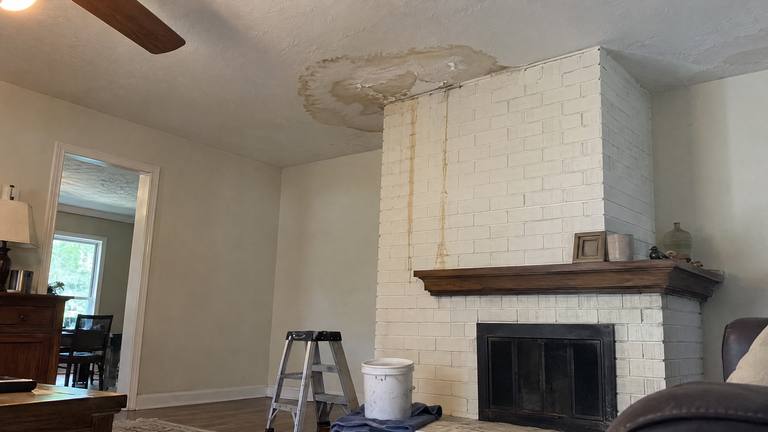
A crown crack does its damage out of sight. Water that gets through soaks the top courses of brick, where it feeds white staining and spalling on the chimney faces. It runs down the flue tile's outer face inside the chimney and reaches the smoke chamber and the damper, which rusts. In a heavy rain it can show up as water in the firebox or a stained patch of wall or ceiling next to the chimney.
So a crown gets checked whenever a chimney shows water damage lower down. The crack at the top can be the source of problems found much further down.
Crown, cap and chase cover are different parts
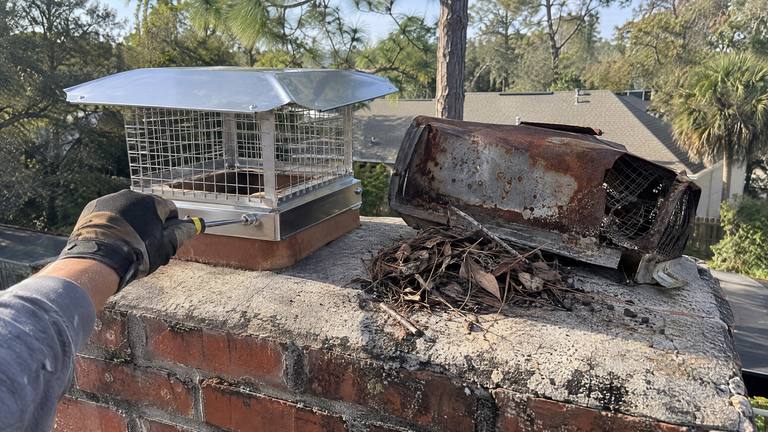
The words get mixed up, and it matters when you are describing a problem. The crown is the masonry slab across the top of a brick or block chimney. The cap is the screened metal hood mounted over the flue opening, above the crown. A chase cover is the metal top of a framed chimney that has no masonry crown at all.
So a cracked crown is a concrete or mortar problem, a rusted or missing cap is a metal part to replace, and a framed chimney with a leaking top needs its chase cover checked instead. The three have separate repairs and separate pages on this site.
How to look without climbing
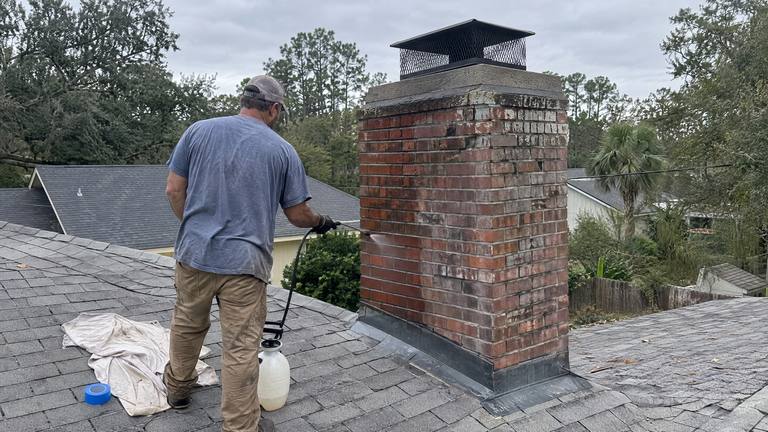
You do not need to go on the roof to get a first read. From the yard, or from a spot with a view of the chimney top, binoculars will show broken edges, missing pieces and a crown that sits flush with the brick instead of overhanging it. The chimney below gives clues too: white staining or flaking brick near the top, and a rusty damper inside the fireplace.
Fine cracks are hard to see from below. A close look from the roof, done by someone with the right footing and equipment, is what tells a surface craze from a through-crack.
Chimneys with more than one flue
Where a chimney carries two or three flues, one crown surrounds all of them, and every tile needs its own bond break. Cracks tend to run between the tiles, where the slab is narrowest and each tile's movement pushes on the same strip of concrete. When a crown like that is recast, the spacing and the joints around each flue are part of the plan, along with a cap arrangement that covers every flue.
Seal, patch or recast
The right repair follows from the crack and from what the crown is made of. The smallest repair that actually fixes the problem is the goal, and the options run in a clear order.
- Seal: hairline crazing or fine cracks in a sound, cast crown get a crown sealant designed for it, applied as its maker directs.
- Patch and seal: a few defined cracks in a solid crown can be opened, filled with a compatible repair material and then sealed over.
- Recast: a mortar wash, a crown with through-cracks, or one that is breaking up is removed and replaced with a cast crown that has a slope, an overhang that drips clear, and a bond break around each flue, per R1003.9.1 and ASTM C1283.
What does not work
Roofing cement smeared over crown cracks traps water and has to be scraped off before a real repair. A new skim of mortar over an old cracked wash bonds poorly and cracks along the same lines. Filling the gap between crown and flue tile solid with mortar removes the very bond break that protects the crown. Each of these makes the eventual repair larger. Our chimney crown repair page describes how recasting is done.
FAQ
Frequently asked questions
Is a cracked chimney crown a problem that can wait?
By itself it is a water problem to fix soon, not an emergency. It becomes urgent when pieces are loose enough to fall onto a roof or walkway, or when water is already coming into the house.
Can I seal crown cracks myself?
Crown sealants are sold for the purpose, and they work on fine cracks in a sound crown when the surface is clean and dry. The hard parts are the roof access and telling a hairline craze from a through-crack or a mortar wash, which sealant will not fix.
Why did a fairly new crown crack?
The reasons to look for are that it was a mortar wash rather than a cast crown, that there was no bond break around the flue tile, or that it was too thin or cured too fast. Any of those can show up as cracking within a few years.
Does a chimney cap protect the crown?
A cap with a wide lid shades part of the crown, but its job is to cover the flue opening and keep out rain, debris and animals. The crown still sheds most of the water that lands on the top of the chimney, so a cracked crown still needs repairing, cap or no cap.
How can I tell a mortar wash from a cast crown?
Check the edge. A cast crown overhangs the brick, with a groove underneath that acts as the drip edge. A mortar wash stops flush with the brick, looks thin at the edges and meets the flue tile with no visible joint.

Proudly American
A family business that answers its own phone.
Our Services
Related services
Guides
Chimney and fireplace guides
-
-
-


Book your free inspection
Call or send the form. The inspection is free and the price is written down before any work.
Free Inspection